
Memorial Ideas

‘How can I remember my child(ren) in a meaningful way?’ is a common question from bereaved parents.

Here are some memorial ideas for your consideration

Immediately following the death:

  • It may be possible to take hand and/or foot prints of your baby(ies). These can be framed in a shadow box with an engraved nameplate. The hospital staff will be able to guide you at/after delivery if this is at all possible. Depending upon how long the infant has been deceased while in utero, it may not be possible to make casts.
  • Have photos taken of both/all of your babies together as well as apart. This will be the only time they will be together and later in life these photos can become extremely important, not only for the parents but also for the surviving co-multiple(s) in actually seeing his/her sibling(s). One family noted that these photos were important in confirming to them that they did, indeed, have another baby. In some areas professional photographers donate their time and take the photos for free. Now I Lay Me Down to Sleep is one such organization. Alternatively, you can take the photos yourself, or ask a friend or hospital staff person to take the pictures for you.
  • Consider taking photos of hands, feet, ears as well. Baby(ies) can be carefully wrapped to facilitate such photos.
 For the funeral or memorial service:
  • Consider releasing homing pigeons either at the baby(ies)’s funeral or memorial. Try the yellow pages or internet for a local business offering this service. The birds are for rent for services and memorials. Note: Releasing mylar helium-filled balloons is not recommended as deflated balloons have been found in the stomachs and intestines of whales, turtles and birds. It is a difficult and sometimes painful death for unsuspecting animals. For the most part, regular balloons are biodegradable, but the strings, ribbons and cords are not. These parts remain a hazard for animals.
  • Consider involving the grandparents in the memorial or special services. They, too, have suffered a loss (and also grieve that they were not able to protect their own child from such a loss), and including them in a part of the service plans will help as you rely on each other’s strengths for mutual support;
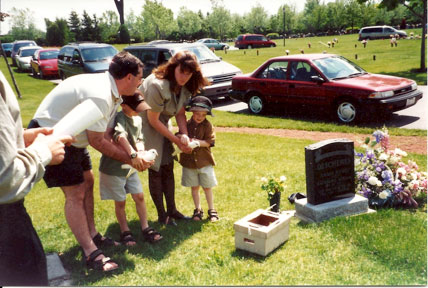
  • Consider involving older children in the funeral and/or memorial service. Young children don’t always understand the concept of death, but involving them in funeral arrangements helps them better understand what is happening and why their parents are upset and sad. Left to their own devices, children can internalize negative feelings and interpret those feelings as if they, themselves, have not ‘been good’ and as a result their parents are sad, upset or angry. Including them and explaining the situation in age-appropriate language ensures they understand that the situation is not their fault, and helps them feel connected rather than left out or marginalized;
  • If the service occurs when there is still a survivor(s) either in hospital or at home with a sitter, allow yourself to be mentally, emotionally and physically present at the service. You are in the right place at the right time, so try not to be hard on yourself with thoughts of your surviving co-multiple(s) and that you should be with him/her/them.

Support at home

One idea, as a bereaved grandmother explains, occurred when her daughter and son-in-law returned home after losing triplet babies.

My daughter is home from the hospital and I will be going to take care of her this coming week so her husband can go back to work. I thought I would pass on what a loving thing their friends did. When my daughter and her husband arrived home, they were greeted by friends who [had arranged] a “shower” of love and comfort. They brought presents like plants for the house, gift certificates to the video store, cooked meals for the freezer, etc. One woman’s gift was to clean my daughter’s windows in a couple of weeks. Since we live in a desert environment, this is a very loving thing to do. They also brought covered dishes and spent time with the couple and just let them guide the conversation. My daughter said she felt so loved and cared for by so many people. One woman (although she was a little nervous about it) brought her newborn (2 weeks old) and let my daughter hold him. This did not upset my daughter. Instead she said it gave her a chance to hold a baby in her arms and it just felt so natural. I thought this was such a wonderful, thoughtful thing that made their homecoming less painful.

On birth or death days

  • Light a special candle on either the birth day or death day or both, whichever works for you;
  • Make a donation in your child(ren)’s name;
  • Do some volunteer work in your child(ren)’s name;
  • Some families spend the birth or death day at the cemetery with a picnic;
  • Some families do not want to take away from their surviving co-multiple(s)’s joy, and so if the death day is the same as the birth day, the family will set aside a different day in which to remember their deceased baby(ies);
  • One couple donates a baby layette each year in their son’s name to a male child born in the same hospital on the day their son died.
  • Consider planting a tree or flowers. One couple planted daffodil bulbs in a forest spot they liked, and went to visit them every spring and just sat in the quiet to think.

Helping a surviving co-multiple learn about their beginnings

Having photos around the house or perhaps making a memorial book can not only help with the grief process but also provide an opportunity for questions at a later point in time. Photos (even just one) around the house will encourage a surviving co-multiple(s) to ask questions, and provide an opportunity to explain and answer questions in age-appropriate language.

Down the road

  • Make a difference in the life of a child and ask the school board if you can help a child learn to improve his/her reading skills;
  • Donate a book to a local school or public library each year in your child’s name;
  • Plant a tree in a private space, or get permission to donate one to a public space;
  • Buy a bracelet and include a charm that might symbolize your child.  This is discreet and it would not be necessary to explain anything you did not wish to share.

Following is an idea from a triplet family who lost one of their young sons at 21 months due to complications from his prematurity.

Our fifth family member…

A friend of mine from Oslo, Norway, who also lost her young son, shared this poem with me. Loosely translated from Norwegian and paraphrased, it reads:

We are four in our family.

We are five in our family.

We have an invisible one in our family.

If you don’t know our fifth family member, you don’t know us.

This poem sums up for me the importance to us of always including our Angel Joey as a member of our family. This is especially so as he is one of our triplets. People will insist on calling our boys ‘twins’… but they are not. We have many pictures of Joey from his brief time with us but every year at portrait time, we want to make sure he is with us. Another friend suggested including some memento of his or even a framed picture in our family portrait. I found a small, stuffed bear with a blue ribbon and holding a wooden block with the letter ‘J’ on it. This is our ‘Joey Bear’. For the past two years, Joey Bear has joined us in our Family portraits. He is a small reminder that we are not as complete a family as we once were. One is absent from us physically but always present in our hearts.

If there has been a baby shower, ideas for what to do with the gifts

Gifts given belong to the receiver. This might not hold true if the gift is a family heirloom, e.g. silver cup or spoon. You may wish to return any special items. However, all other shower gifts or gift certificates can be kept by the receiver or returned, as you see fit. An option might be to donate some, or all, of it to a needy cause such as your community home for unwed mothers or other charity. If this latter option is chosen, think about writing a note to the giver of the gift and letting them know that their generous gift has been forwarded to a worthy cause. Reasons that gifts/certificates might be passed along include: the parents feel unable to keep them as they are a reminder of their loss, fear of more “bad luck” or parents want their next pregnancy to have a more positive outcome.

Organizations

Multiple Births Canada – Loss Support Network
Telephone: (705) 429-0901 Toll Free in Canada: 1-866-228-8824
WS: www.multiplebirthscanada.org
Email: loss@multiplebirthscanada.org

Center for Loss in Multiple Birth (CLIMB)
Jean Kollantai, PO Box 91377 Anchorage, Alaska 99509 USA Telephone: (907) 222-5321 WS: www.climb-support.org
Email: climb@pobox.alaska.net

The Compassionate Friends of Canada
Tel: 1-866-823-0141 WS: www.tcfcanada.net
Email: nationaloffice@tcfcanada.net

Bereaved Families of Ontario (BFO)
Canada Telephone: (416) 440-0290 WS: www.bereavedfamilies.net
Email: admin.bfo@axxent.ca
Email: info@bfotoronto.ca

Books

  • Forever Our Angels, Hannah Stone, Lulu Publishing (2006).
  • Empty Cradle, Broken Heart: Surviving the Death of Your Baby, by Deborah L. Davis, Fulcrum Publishing (revised edition 1996).
  • The Worst Loss: How Families Heal from the Death of a Child, by Barbara D. Rosof, Henry Hold and Co., N.Y. (1995).

Suggested Loss Reading List

There are many helpful books on loss and grief available. Here is a loss reading list of some that I have found to be particularly helpful and supportive. I am very pleased to note that support literature for surviving co-multiples is on the increase.

If you have a read a book that you have found helpful and would like to share it, please let me know.

Step into the Light: Living in the Shadow of the Ghosts of Grief , Alan D. Wolfelt, Ph.D., Companion Press, 2007, 152 Pages, ISBN 978-1-879651-51-7 $13.95US; $17.95Cdn.

Wolfelt has written many thoughtful and supportive books on grief and here is another one.  He looks at why many of us carry our grief rather than mourning it.  It isn’t uncommon to feel afraid to face what hurts us.  We may fear losing control and never getting it back.  We may fear crying and never stopping (in fact, we do eventually stop crying.  After about 20 minutes, our body slows down and crying stops).  We may be under the impression that if we do not face our losses, then they didn’t really happen. We may be under the mistaken impression that if we “ignore” the pain, it will go away.  We may fear that the pain will be so great that we could “break.”  As common as such feeling or perceptions may be, Wolfelt encourages the reader to address that which we fear will destroy or cripple us and to mourn so that we can move forward and “step into the light.”  If we do not so, the grief will never leave us and will be carried forward with us to raise its ugly head and undermine us at every opportunity.

Here are a few quotes (from several) which touched me:
Only when we are no longer afraid do we begin to live – Dorothy Thompson
If my grief softens, I’m afraid I’ll have to admit he is never coming back.  And that is what I don’t want to face.  A workshop participant.
One heals suffering only by experiencing it to the full.  Marcel Proust

If the reader has difficulty in recognizing his/her pain, grief, physical problems or addictions, Dr. Wolfelt has included a survey to assist with learning about and/or recognizing which issues readers might be experiencing.  When it is all in a list before us, it can be helpful in coming to terms with what we are (may be) dealing and help us move forward to get the help and support need.

Another thing I appreciated about this book was the almost “interactive” nature of it.  Wolfelt encourages the reader to read the book with a pen and to underline anything that speaks to you, and/or to create a reflective journal of those words, phrases, paragraphs which meant something to you, and to add your own thoughts and feelings as you progress, hopefully towards the light.


Always My Twin
, by Valerie R. Samuels and Illustrated by Najah Clemmons, Trafford Publishing, 28 pages, softcover

At last a book for young co-twin survivors! Samuels gave birth to twin daughters Gina and Julia at term. Gina had Trisomy 13 and Holoprosencephaly and lived for 9 days. As Samuels describes, “She died in my arms, but not in my heart.” In order to honour Gina and help Julia deal with her loss, Samuels wrote this book. It is narrated by Julia who explains her parents sadness at losing her sister and joy with having her.  It is an easy to read children’s book, using language aimed at about age 5. It explains how the pregnancy began as two and that one of the babies died.

Always My Twin  is interactive in that the reader can complete sentences explaining how they feel about losing their co-twin, paste in a photograph and complete their own Family Tree. The touching illustrations “speak” so that the young reader can understand and perhaps relate to what they, too, might be feeling.

The book may be little, but it fills a gap for young co-multiple survivors in a big way!

If you are interested in purchasing a copy, it can be ordered online at: trafford.com/05-0937 or from Valerie herself at samuelsvr@yahoo.com

Sibling Grief: Healing After the Death of a Sister or Brother, P. Gill White, iUniverse Inc., 2006, softcover, 112 pages

When a child dies, people close to that child feel the loss: the parents, the grandparents, the siblings. While we tend to focus on supporting and providing resources for parents, the grandparents and siblings also have unique experiences. This book focuses on sibling loss and as bereaved parents, we need to be aware that the loss of our child(ren) also affects our living children. Depending upon the age of each child when his/her sibling dies and under what circumstances (born still, illness, accident, suicide), the situation can be very difficult for siblings as well. Not only are their parents not emotionally available to them for an amount of time (sometimes years), they have lost a comrade, partner, playmate, friend, confident and so much more.

While this book does not touch on multiple-birth co-sibling loss and the unique challenges faced by the survivors, nevertheless, there are many parallels included which parents will be able to relate to, understand and act on to support and assist their living co-multiples in dealing with a co-sibling’s loss.

White, who lost a sister when she was 15, has broken her book down into the different ages at which loss might occur and provided guidance and insight for parents at each stage. She breaks down the healing practices into 5 steps: learning about sibling loss and the grief process; allowing yourself to grieve; connection with other bereaved siblings; telling your story; and finding meaning in the loss.

There are a plethora of resources listed in her helpful and supportive book, also broken down into detailed categories so that bereaved siblings can make other connections as they might need. This book would not only be a terrific resource for professionals whose clients are looking for grief support around the death of a sibling but also for parents having lost a child(ren) and suporting/helping their surviving child(ren) deal with their own emotions around the loss.

Journeys: Stories of Pregnancy After Loss, edited by Amy L. Abbey, Woven Word Press, 2006, 183 pages, softcover

Losing a child is a parent’s worse nightmare. In our fantasies about our lives and how they will play out, we never envision that we will lose a child. In fact we have the most beautiful baby (or babies) in the world and everyone lives happily ever after. The truth is, that sometimes parents lose their baby. There may be no discernable rhyme nor reason to the loss, making the loss much worse as we blame ourselves, our bodies, the world.

Getting pregnant after a loss has additional issues: Will we lose another pregnancy? What are my chances of losing another pregnancy? When is the optimum time to try again? When another pregnancy does occur, time lines can be emotionally depleting, especially if they mirror those of the unsuccessful pregnancy. Such fears and questions are normal.

Journeys: Stories of Pregnancy After Loss, edited by Amy L. Abbey, chronicles stories of loss by parents whom have suffered the worst kind of loss. This touching and caring book speaks to the pain of losing a much-wanted and loved baby, through miscarriage, stillbirth or just after birth. One by one parents recount how their pregnancy progressed, some knowing ahead of time that their precious child would not live to feel the sun. Parents speak to their innocence about their pregnancy, their joys, and about the journey of the distress of their loss. Some share their disbelief with the news of their child’s prognosis and of processing that knowledge. They share how they coped through their loving relationships with each other, family and friends. Some had other children but the emptiness remains in spite of the subsequent joy of the birth of a healthy child.

I think it is important not only to tell the stories of precious lives lost, but also in letting us know that we are not alone in our grief. By sharing their stories, these courageous parents have honoured the short lives of their babies while at the same time extending a hand and loving spirit to other grieving families experiencing the same situation. Together we are so much stronger and the path, while still bumpy and often uphill, is somehow made a little better.

  • The Loss of a Multiple: Miscarriage, Stillbirth, Infancy , Multiple Births Canada
  • The Loss of a Multiple: Childhood, Teens , Multiple Births Canada
  • Empty Cradle, Broken Heart: Surviving the Death of your Baby , Deborah L. Davis, Fulcrum Publishing
  • Living When a Loved One has Died , Earl A. Grollman, Beacon Press
  • Men & Grief (a guide for Men surviving the Death of a Loved One), Carol Staudacher, New Harbinger Publications
  • On Children and Death , Elizabeth Kubler-Ross, Collier Books
  • Questions and Answers on Death and Dying , Elizabeth Kubler-Ross, Macmillan Publishing Co.
  • When a Baby Dies: A Handbook for Healing and Helping , Rana K. Limbo and Sara Rich Wheeler, RTS Bereavement Services
  • When Hello Means Goodbye: a guide for parents whose child dies before birth, at birth or shortly after birth , Pat Schwieber and Paul Kirk, Perinatal Loss
  • The Worst Loss: How Families Heal from the Death of a Child , Barbara D. Rosof, Henry Hold and Co., N.Y.
  • Forever Our Angels, Hannah Stone, 2006, Lulu Publishing, 96 pages, soft cover, $7.95 US.
    Web site: http://www.lulu.com/content/216306

Hannah Stone suffered three pregnancy losses along with the births of five healthy children.  Each of her children were much-wanted but not all of her babies were able to stay to be a family on earth.  While Hannah located books on loss, grief and others offering coping strategies, they did not meet her needs of wanting to know her feelings were normal and not feeling as if she needed to hide her loss.  As such, she decided to create the book she never found in the hopes that others might also find solace as she needed.

Her book, while not addressing multiple birth loss, is a collection of about 15 personal stories of miscarriage.  Grieving parents share their confusion, grief, numbness, having to put on a ‘happy face’ for others and some acknowledge their anger at God for taking their baby before s/he had a chance at life.  This is not a book about being fair.

When we share our grief and say our baby’s(ies) name, we honour our Little Lights of Life and confirm that our Forever Angels remain in our hearts.  The future is forever changed.  Parents learn that the world can be a cruel place and their discussion centres around the struggle to find a new “normal.”

While Forever Our Angels rips at the heart, families suffering the early loss of much wanted babies, will no doubt find comfort in knowing they are not alone in their grief.

Remembering Our Angels: Personal Stories of Healing from a Pregnancy Loss, Hannah Stone, www.lulu.com, March, 2007, softcover, 138 pages

Courageous and very sad families have shared their stories of loss(es), how they have handled their loss and how their lives have changed as a result of losing their precious baby(ies). While these stories are difficult to read, they are also compelling and the fact that these parents are honouring their children by sharing each aspect of their short lives, the reader cannot remain untouched. In fact, we shouldn’t be untouched. Nothing about losing a baby is fair or right.

Stone includes one family’s story of loss of one twin, and I submitted an article addressing some of the challenges multiple birth families must face and how friends, family, professionals and the community can do their part to support and assist each bereaved family.

For Surviving Co-Multiples

  • The Survivor , Lynne Schulz, 2003, Pleasant World – with Foreward by Lynda P. Haddon
  • Living Without Your Twin , Betty Jean Case, Tibbutt Publishing
  • The Lone Twin: Understanding Twin Bereavement and Loss , Joan Woodward, 1998, Free Association Books
  • The End of the Twins: A Memoir of Losing a Brother, by Saul Diskin, The Overlook Press
  • Twin Loss: A Book for Survivor Twins, by Raymond Brandt, Courier Printing Co.

Household Tasks: Teaching the Kids to Pitch In

Sharon Schnupp Kuepfer, Mom to five children ages 4 to 10, including twins, is the author of a book Homeschooling Moments and Child-Friendly Recipes: A Collection of the Unique Adventures of a Mennonite Family. The following hints for encouraging children to assist in the day-to-day household tasks are adapted from her book and an article in The Toronto Star (27th April, 2002).

Delegate – Each child takes one weekday to help with lunches and suppers. Sharon’s oft repeated rule: “If everyone does a little bit, no one has to do a lot.”

Assign new jobs periodically – As the children get older, they can handle more challenges. A five year old can easily handle the job of bringing the laundry down to basement on washdays. By aged three, Sharon’s twins were capable of putting the clothes in the washer, then transferring them to the dryer. To make the job easier for them, she bought them a two-step stool. They were thrilled!

Assign the same task for long periods – Not only does this lighten the workload, it makes the children competent in their assigned task. Sometimes they may even enjoy the task. At 9 years old, her daughter had had floor care for a year. Not only did she become adept at floor cleaning, she advised that she liked her job.

Use the five-minute motto – Sharon told her children that a job shouldn’t take more than five minutes. It is helpful to a child to realize that a job doesn’t have to take “half a day” to complete. Five minutes to empty the dishwasher, five minutes to sweep the kitchen floor, five minutes to sort the laundry, five minutes to wipe down the bathroom. Soon the jobs are done.

Kids complete chores even if there is company – Company kids are invited to join in the tasks, but don’t have to. Often when company sees your own children working, they will pitch in too. The timer is set for five minutes and everyone works like mad and Sharon finishes what is left. *Everyone contributes to the mess and everyone contributes to the clean-up. 

Let them work when the mood strikes – Sharon wanted to spend some time with her only son. “What shall we do?”, she asked him. “Let’s organize the closets”, he responded. While Sharon had had a play task in mind, she didn’t argue with his suggestion.

Be a role model – Even when the kids were not in the mood to work beyond their regular chores, Sharon cleans regularly. In this way, the kids observe that there are other tasks around the house that also need attending to.

Be consistent – Sharon notes that she is a stickler for having the tasks completed. Unless the child is very sick (or has another good reason), tasks must be done!

Make moves and minutes count – Sometimes multi-tasking is really helpful and even the children learn how to double up on their chores. Sharon’s seven-year old daughter advised “While I am waiting for my hot chocolate to get warmed up, I do my dishwasher. This way I have less to do later on.”

Make sure you have the right cleaning and organizing tools available – Make sure that you have the right tools on hand to complete tasks. Purchasing a good dust mop, for example, saved Sharon’s daughter a good deal of time daily when mopping the floor. It’s no good to begin cleaning the mirrors or glass, for another example, if you do not have the right products on hand to do so.

Bedrest

Question: I am pregnant with multiples and have been ordered to bedrest by my doctor. How will this help my babies? How will I pass the time? How can I relieve the boredom?

It isn’t unusual for a woman expecting multiples to be placed on bedrest. There are many reasons why this might be necessary. They include: water retention spotting, high blood pressure, signs of premature labour, one or more of the babies not growing at a satisfactory rate (e.g. weight discrepancies between the babies, babies not developing at the same rate or gestational diabetes, a pregnancy-related diabetes). Bedrest produces many benefits for both mother and babies. It relieves the pressure on the cervix and assures that calories and nutrients that would normally go to the mother’s activities are diverted to the babies.

There are several different levels of bedrest:

  • At home in bed or lying down, being allowed up for very short periods of time;
  • Hospitalized and allowed up for bathroom privileges only;
  • Hospitalized and not allowed to leave the bed;
  • Hospitalized and the bed tilted with your feet upwards (tredelenburg position); and
  • Hospitalized weekdays and allowed out on the weekends with specific instructions.

It is not always easy to be hospitalized. You may have other children at home and this can be traumatic and upsetting for everyone. Stress related to additional child care situations can be harmful. Use your support systems: family, friends, neighbours. People love to help but aren’t always aware of what you might need.

If you are permitted to leave the hospital, this can help alleviate some of the pressure of not being available for your child(ren) while maintaining a safe environment for your unborn babies. When explaining to your child(ren) why Mom is not at home, use clear, comforting, age appropriate language. Whenever possible, take the child(ren) to the hospital for a visit, allowing them to see for themselves where Mom is and what her day involves. If your child(ren) doesn’t want to go to the hospital, try to accommodate their wishes. Keep the child(ren)’s routine the same, whenever possible.

There are many things that you can do to help pass the time while on bedrest:

  • Read and learn all about multiples and your unique and special situation;
  • If you have access to a laptop, check out many of the helpful web sites regarding multiple births: Multiple Births Canada;
  • Keep a calendar by your bedside to cross off the days;
  • Pick one night a week to do something special with your partner: order in supper, watch a movie;
  • Knit, crochet, needlepoint, write letters, phone friends;
  • Keep a daily journal. It is very rewarding and fulfilling to look back on this period of time and share it with your children.
  • Ask if there are any other mothers expecting multiples also on bedrest. Sharing with someone in the same situation can provide comfort, companionship and a chance to share experiences.

For mothers expecting higher order multiples (triplets, quadruplets or quintuplets), it is almost inevitable that an extensive period of your pregnancy will be spent on bedrest. Be aware of special exercises which will help decrease joint and muscle stiffness in bed. One mother of twins hired a massage therapist a couple of times during her 9 weeks on bedrest. Ask to speak to a physiotherapist while in the hospital. Doing exercises will assist you after the babies birth and assist your recovery. You may also need ongoing physiotherapy after the babies are born if any of your muscles have atrophied. Walking may be uncomfortable initially because of pelvic bones shifting back into place and sore, achy muscles. As well, softened skin on the balls of the feel may need to harden again.

This time spent on bedrest can make a positive difference in the health of your babies, assisting them in gaining weight and completing their development. Each day your babies remain in utero, is one less day they will need to spend in a Special Care Nursery. There can be no safer environment for your multiples than that which your body can provide.

Most of us are highly motivated, busy, active people accomplishing a great deal. It can be quite difficult for a person who is used to activity to be forced to remain quiet and in bed. Many women still feel healthy but are forced into an “illness” role. It is not uncommon to experience negatives feelings in this situation. It is important that a support network be used to discuss these feelings. You are not alone. Many multiple support groups offer a bedrest support line, staffed by women who have been in your situation. Contact your nearest multiple birth support Chapter for further information.

Additional Resources:

  • Eating Well While on Bedrest, by Julia Watson-Blasioli and Pauline Brazeau-Gravell, Ottawa Hospital, General Campus
  • Twins! Pregnancy, Birth and the First Year of Life, by Connie L. Agnew, Alan H. Klein and Jill Allison Granon
  • Multiple Blessings by Betty Rothbart, Hearst Books
  • The Joy of Twins and Other Multiple Births, by Pamela Patrick Novotny, Crown Paperbacks, Inc.
  • Finding our Way, life with triplets, quadruplets and quintuplets – A collection of experiences
    Triplets, Quads, Quints Association, Web Site: http://www.tqq.com

“Bedrest” written and developed by Lynda P. Haddon and Sandra Tompkins


Multiples in School

Pat Preedy became interested in school issues around multiple birth children in 1992 when nine sets of twins showed up at her school in Solihull, West Midlands, England to begin primary school. This brought the number to ten sets when added to the set already enrolled.

Pat Preedy, Ph.D., Key Note Speaker, Multiple Births Canada Conference, Ottawa, 23rd May, 2003, Submitted by Lynda P. Haddon

Pat began working with Professor David Hay of Australia and together, luckily for parents of multiples worldwide, created an important resource Web Site,www.twinsandmultiples.org, for parents asking the important question: should they be together or separated? Taking their research even further, Pat and David have also provided important feedback for educators in assisting each co-multiple to be the best they can be.

Pat began her talk by explaining that she and David had identified three main categories of multiples: Extreme Individual, Mature Dependent and Closely Coupled. Here are the traits as they identified them:

Extreme Individual

  • likes own friends, doesn’t share friends
  • plays mostly alone
  • opts out of the interaction if his co-multiple is successful
  • polarises his/her behaviour, goes to extremes (angel/devil)
  • is excessively competitive
  • dislikes co-multiple(s)
  • refuses to dress alike
  • tries to dominate

Mature Dependent

  • shared and separate friends
  • are happy either separated or together
  • supportive of co-multiple(s)
  • has developed as an individual with own identity
  • may choose the same or different interests from co-multiple(s)

Closely Coupled

  • unhappy when separated, want to be together most/all of the time
  • respond to each others’ names/group name, e.g. “Twinnie”
  • cannot recognize his/her image in the mirror
  • uses twin “language” (cryptophasia)
  • each slows down/speeds up to keep together, especially in school
  • few or no individual friends
  • combines to form a unit
  • dress and behave identically

Pat presented some ways to assist and support multiples in becoming individual thinkers, both by parents and educators alike

  • make individual eye contact so that each child is aware that you are speaking only to him/her.
  • use the child’s name at the beginning of the sentence, followed by your request or instructions. This gets his/her attention and there is no confusion for the children as to whom you are addressing.
  • ensure that each child speaks for her/himself and that the other does not do all/most of the talking/responding.
  • if you are having difficulty in “getting through” to one, both or all of the children, use play to engage them in conversation. Through playing a game with them, the parent or educator can create scenarios and engage a child, asking how they might respond, or what they might be feel if such a such a situation were to arise. When done through play, most children will let their guard down and express what they are thinking. A play situation vs an actual situation permits relaxed feedback from the child.

Pat reminded us that one of the “problems” experienced by multiples is their lack of privacy from each other. Pat cited an example: if the parents send one multiple to camp, they are usually sending two or three. Hence multiples do not have the same experience as if only one child was going to camp. Sent together they do not have time away from each other, are not encouraged to make individual friends or develop individual interests. They are inadvertently set up to continue to rely on each other and hence experience a lack of privacy from each other.

Pat stressed that both parents and teachers have the ability to assist multiple birth children in becoming the best they can be. Both need to be aware of the categories of twins as identified above and into which category each set of multiples may fall. When it can be determined as to how the multiples may be linked, both parents and educators can be properly assist and support the children reach their full potential. Pat advised that failure to recognize the challenges that multiples face from either being together or separate in their early schooling years is “unconscious incompetence.”

Pat’s talk was well attended by 100+ delegates, mostly parents, whose children are at or near school age and whom want to make the right decisions regarding their children’s class placement. Even though advance notice of Pat’s presentation was made several times to the local School Boards, including those up and down the Ottawa Valley and Eastern Quebec, attendance by educators was disappointing and pretty well limited to those with multiple birth children.

Schools don’t yet realize the part they can play helping/supporting multiple birth children and their parents with placement challenges. Nor do they recognize their important support role in assisting multiple birth children in making the transition into school and in separating from each other. The lack of representation for Pat’s Key Note and Workshop presentations from daycares, educators, principals and School Boards reinforces for me, that Boards underestimate and may not recognize the importance of their roles in class placement decisions, in being informed regarding the issues around multiples in school and therefore indeed function in an “unconscious incompetence.”

What to Bring to the Hospital: ideas for Mom, Dad/Partner, Babies

A common question, especially for first time parents, is “What do I need to pack for the hospital?” Here are some suggestions for all of you:

For Mom

  • Toothbrush and toothpaste
  • Hairbrush/comb and shampoo
  • Any other toiletries you might like, e.g. make-up, face creams
  • Two loose fitting nighties, preferably the breastfeeding kind. You will probably be wearing a hospital gown during for your delivery.
  • Slippers
  • Housecoat
  • You may sleep more comfortably with your own pillow(s)
  • If you want underwear and can’t find anything that fits, try men’s boxers – they are amazing, come in very large sizes and will go above your large belly before birth and above the incision in the evenr you have of c-section
  • Some people like to bring their own music but make sure you also bring earphones so as not to disturb anyone else
  • You could bring a journal for writing in
  • You might bring reading material, knitting or crocheting. These can help pass the time for someone on bedrest or after the babies are born
  • I found it very helpful to have some tiny mints such as Tic Tacs for use during labour. You aren’t allowed to eat or drink (other than some ice chips) and your mouth gets so dry from all of the mouth breathing during labour. Tic Tacs are perfect for this period of time
  • Clothing to come home in

For Dad/Partner

  • If labour is long, you might want some reading material for when your spouse is sleeping or resting
  • Toothbrush, toothpaste and shaving equipment
  • How about a thermos of coffee so you don’t need to leave the birthing room?
  • Maybe a change of shirt, if you are to be there for a while
  • Some hospitals let dad/partner stay over night. Pyjames are a really good idea
  • Phone list of family members and friends you want to call after the babies are born

For the Babies

  • Initially they will probably only need a diaper, which the hospital provides
  • For low birth weight or premature babies, you may wish to purchase little nightshirts that are monitor friendly (the hospital can guide you as to when the babies can wear them)
  • When the babies leave the hospital, you will need a weather-appropriate outfit per child
  • Light blankets (or heavier if it is Winter) per baby to bring them home
  • Rear-facing car seat per child

Resources

  • Multiple Births Canada for information on car seats, and all things multiple births
  • Ever So Tiny – for premature and monitor friendly clothing and Twin Nursing Pillows
  • 2 by 2 Multiples – The fun site to go shopping for your multiples.
  • BabyLinq – An online resource for the popular Maya Wrap Sling baby carrier and other baby items and parenting tips. Geared particularly to the preemie and micro-preemie, their beautiful and soft clothing fits the smallest among us and is versatile enough to be used easily with medical monitors and tubes.
  • Chia’s Breastfeeding Friendly Clothing – Lindy Mertick’s line of breasfeeding clothing is manufactured by her home based business. This website has useful tips, breastfeeding info, mothering support and an extensive on-line catalogue.
  • Extraordinary Baby Shoppe – Great diaper information, diaper bags, items for Mom-to-be (maternity underwear), Mom, breastfeeding, slings, baby food.
  • Graco – Wonderful variety of baby products: strollers, car seats, backpacks.
  • Milkface Nursingwear – Your online breastfeeding resource! Young, modern and fashionable clothing for breastfeeding mothers as well as accessories to enhance your nursing relationship, from nursing bras to baby slings. Special services available to customers in the Ottawa, Ontario, Canada area.

Multiples in School: Parent Tips

Two concerns that arise for parents with multiple-birth children are whether they should be in the same class at school or separated, and which type of placement would benefit each child’s personal development.

In some schools there may be enough classes of the same grade to facilitate each child being in separate classes. It isn’t unusual for some schools to make the blanket policy that all multiples must be separated. In order to assist you with your decision making, the following offers some considerations for both leaving the children together as well as for separating them.

Pros to Separation

Although there is no substantial evidence to support the policy that multiples must be placed in separate classrooms in order for them to grow and develop as individuals, there are sometimes some circumstances which would indicate that separation is advisable. Here are some examples for when separation may be in the best interests of each child:

  • constant “togetherness” is hindering the development of social skills in one, both or more;
  • a “division of labour” exists;
  • insensitive comparisons by teachers, peers or even each other have led to feelings of inadequacy in one or more of the multiples;
  • the multiples form a “power unit” which is causing disruptive behaviour;
  • the kids use their multipleship to exploit, cheat or play tricks;
  • one or more of the multiples appears to resent the lack of privacy resulting from sharing a classroom;
  • one multiple proves to be a constant distraction to the other;
  • in opposite-sex multiples, the female is overprotective or “mothering” of the male co-multiple;
  • in skill grouped classrooms where the abilities of one multiple are far above those of his co-multiple; and
  • the multiples WANT to separate.

Wise parents and educators will realize that some of the above issues may be evident in one year and not the next. Evaluations/observations of multiples’ behaviour and development need to be regularly monitored.

Cons to Separation

Sometimes there are valid reasons for keeping multiples together:

  • major emotional upheavals may have occurred within the family, e.g. death, divorce, moving house, etc;
  • only one classroom is available;
  • unequal education due to two different teachers employing different methods of teaching;
  • multiples are at or near the same skill level in a skill-based classroom.

Recommendations regarding school placement

  • It is not recommended separating multiples who want to be together. Forced separation can damage self-esteem, inhibit language development and delay learning.
  • It is not recommended to automatically separate multiples in their first year of school. Such a separation adds to the stress of starting school and may actually increase the multiples’ need to be together.
  • All multiples need as much independence as they are ready to handle. Multiples flourish when allowed to separate on their own timetable. Together or not can be evaluated each year. As the multiples grow older, they themselves, will also have input as to whether or not they should be together.
  • Encourage multiples to choose separate classes and/or other activities as they gain confidence in the school situation.
  • Decisions as to whether or not the children should be together is best made by a “team” approach – the parents, the teachers and the principal. Educators need to realize that parents know their children best and it is important, for an easy transition to school, that a parental opinion be considered.
  • If multiples are in the same classroom due to lack of other classes, they can be in separate settings within the room;
  • The placement of each set of multiples needs to be evaluated on a family by family basis, placement evaluation needs to occur on a annual basis with parents, teachers and principals included in the decision-making. At some point, the children themselves will also have input into the decision.

Some Additional Considerations

  1. If your children look a lot alike or very similarly, dress them differently to make it easier for both teachers and peers to easily identify them. Different hair cuts or styles for girls can help too;
  2. Avoid referring to them as “the twins” or “the triplets” as this labels and reinforces them as a group and encourages the public to see them as such rather than the individuals they are;
  3. For parent/teacher interviews, make sure each child is described in comparison with their peers and not solely as compared to each other;
  4. If possible, scheduling parent/child interviews separately can be helpful in allowing you to focus on each child individually;
  5. Be a positive voice for your children and recognize their individual strengths as well as what may make the situation more challenging vis-à-vis them being multiples.

Pat Preedy (UK) provides this important note for Parents: “The critical thing is developing “mature dependence” which needs to begin as soon as the children are born. For multiples who are mature dependents, it actually doesn’t matter whether they are together or apart – they function as individuals and enjoy being a multiple.”

Sources

  • Multiples in School , Multiple Births Canada, Revised 1999
  • Placement of Multiple Birth Children in School , A Guide for Educators, National Organization of Mothers of Twins Clubs, Inc., 1991

Additional Resources

Multiples in School Support Kit, Multiple Births Canada www.multiplebirthscanada.org

Website

www.twinsandmultiples.org, Educational Web Site for Multiples in School, Pat Preedy, M.Ed., B.Ed. (UK) and Professor David Hay (Australia)

Books

  • Parenting School-Age Twins and Multiples , Christina Baglivi Tinglof, 2007
  • The Joy of Twins by Pamela Patrick Novotny, 1988
  • Twins, Triplets, and More , Elizabeth M. Bryan, 1992
  • The Art of Parenting Twins , Patricia Maxwell Malmstrom and Janet Poland, 1999


Multiples in School: A Guide for Educators

Parents of twins, triplets or more face a challenge as their children begin school: should they be together or separated?

Some schools have a policy based on the separation of multiples. Such a policy doesn’t allow for input from the parents nor the children themselves. Not all multiples want to be together and some do well together and need to be able to at least catch a glimpse of their co-multiple across the room to be the best they can be. The important thing is for them to develop “mature dependence.”

In order to assist Educators, the following offers a brief overview of both points of view, i.e. together or separate, and provides additional research material at the end of the article.

Reasons for Separation

While there is no substantial evidence to support the policy of separation in order for each child to grow and develop as individuals, sometimes circumstances exist which would indicate that separation is advisable. It is helpful to recognize that some behaviours may be an issue one year and not the next.

  • Their constant “togetherness” is hindering the development of social skills in one, both or all;
  • A “division of labour” exists;
  • Insensitive comparisons by others have led to feelings of inadequacy in at least one multiple;
  • A child’s problems are attributed to the fact that he is a multiple;
  • The multiples form a “power unit” causing disruptive behaviour;
  • Multiples exploit their multipleship to cheat or play tricks;
  • One multiple appears to resent the lack of privacy resulting from sharing a classroom;
  • One multiple proves to be a constant distraction to the other(s);
  • There is (excessive) competitiveness between the multiples;
  • In opposite-sex multiples, the female is overprotective of her male co-multiple(s);
  • In skill grouped classroom activities where the abilities of one multiple are above that of his co-multiple(s);
  • The multiples WANT to be separated.

Reasons for Not Separating

  • Major emotional upheavals have occurred within the family – i.e. death, divorce, move, new siblings, etc.
  • Only one classroom is available;
  • Unequal education due to different teaching styles of the educators;
  • Multiples are at or near the same skill levels in a skill-based classroom;
  • The multiples do NOT want to be separated. Forced separation, with all of the other “firsts” children face, especially in their first year of school, can add undue stress, regression and affect self-esteem.
  • Separation in the first year of school should not be an automatic decision. The added stress of separation with all of the other firsts (e.g. leaving Mom, rules, increased noise levels, schedules, new friends, etc.) might actually reinforce their need to be together.
  • Allow multiples as much independence as they are ready to handle. They flourish when allowed to separate on their own timetable.
  • Encourage them to choose separate classes as they gain confidence in the school situation.

Tips for Teachers of Multiples

  • Encourage them to sit apart for different class activities if they are in the same classroom. This assists you in identifying who’s who and discourages them from completing each other’s work;
  • Look for differences in the multiples, not sameness, e.g. voice differences, left/right handed, birthmarks, hair growth. Being able to address each multiple by their individual name, assists them in recognizing that they are individuals;
  • Refer to each child by their own name. This helps you identify each child and sets a good example for their peers to also address them individually;
  • Expect differences in test scores, neatness, behaviour but don’t be surprised if they are very similar;
  • Avoid insensitive comparisons, e.g. “You are not doing as well as your twin.” This sets up both multiples to have poor self-esteem;
  • For parent/teacher interviews, compare each child to their peer group and not to each other;
  • if you are having difficulty in telling the children apart ask the parents to dress them differently. This helps everyone recognize their individuality.
  • If one multiple (especially monozygotic [identical] multiples) is markedly behind his co-multiple, investigate the cause:
    1. Check to make sure that each multiple is doing his/her own work.
    2. Plan a conference with the parents to explore the situation.
    3. Don’t rule out the possibility of a learning disability in one of the multiples.

Recommendations Regarding School Placement

It is best if each set of multiples is evaluated each year to ascertain which is the best situation for them, i.e. together or apart. The final decision as to which it will be needs to be made by the parents, the teacher, the principal and at some stage, the children themselves.

Compiled and adapted from “ Placement of Multiple Birth Children in School, A Guide for Educators” a publication of National Organization of Mothers of Twins Clubs, Inc., 1991

Additional Resources

Multiples in School , booklet by Multiple Births Canada,www.multiplebirthscanada.org
Multiples in School Support Kit by Multiple Births Canada http://www.multiplebirthscanada.org
Twinline Services, “ Twins in School: Together or Apart”, Berkeley, CA, 1983

Website

www.twinsandmultiples.org, Educational Web Site for Multiples in School, Pat Preedy, Ph.D., M.Ed., B.Ed. (UK) and Professor David Hay (Australia)

Books

  • Parenting School-Age Twins and Multiples , Christina Baglivi Tinglof, 2007
  • The Joy of Twins , Pamela Patrick Novotny, 1988
  • Twins, Triplets and More , Elizabeth M. Bryan, 1992
  • The Art of Parenting Twins , Patricia Maxwell Malmstrom and Janet Poland, 1999

Multiples and Co-bedding

Co-bedding is the term used to describe putting your babies down to sleep together in the same crib. Most parents co-bed their babies for at least part of the time once the babies arrive home. Our girls slept in the same crib for 4 months until they began to disturb each other. Co-bedding for multiple birth babies just seems to make sense and there are some practical reasons to do so.

Some parents of low birth weight (LBW) or preterm multiples wish to co-bed their babies right after birth in the Neonatal Intensive Care Unit (NICU) but not all hospitals have a co-bedding policy. It’s a tough call and hospitals have some valid reasons for not co-bedding, not the least of which is that the beds may not be big enough to comfortably accommodate two babies. Thankfully though, some Canadian hospitals are rethinking co-bedding issues and as a result, there could soon be some good news for parents of multiples.

Babies co-beddingA quick poll of parents with twins regarding their experiences resulted in the following comments regarding the co-bedding of their babies in NICU:

  • takes less room by your hospital bed, which is important if you are sharing a room;
  • there seems to be less confusion in the nursery as the staff only has to worry about one bassinet;
  • helps the babies conserve body heat, regulate their temperatures;
  • helps the babies settle better as they seem to comfort each other;
  • one mother felt it helped them get over the trauma of their births as they took comfort in being together once again;
  • continuity of their being together from the womb;
  • sometimes babies have been placed in their own bassinet in different nurseries within a hospital setting, making it difficult for the parents to split their time between the two babies and leaving them feeling guilty about whom they were not with. Or the parents would split up to spend time with each baby, thereby not permitting parents to take joy together in their babies;
  • parents generally felt better themselves that their babies continue to be together, as they were in the womb;
  • one family reported that one of their sons was too sick. It just wouldn’t have worked for them; and
  • it is very cute in pictures!

Healthcare professionals have some valid concerns regarding co-bedding

  • if one (or both) babies are sick and are co-bedded, there could be a mix up with their medications. In separate bassinets, the potential for medication error is minimized;
  • if only one baby is ill, there could be cross-contamination to the other baby;
  • if one baby has a birth anomaly, e.g. spina bifida or Downs, it would be better for the babies to be in separate bassinets;
  • there could be unnecessary exposure of a baby to oxygen;
  • there could be sleep disturbances which may impact on a baby’s ability to become healthier;
  • bassinets are not large enough to hold two babies;
  • one baby may interfere with the tubing of the other baby; and
  • there could be temperature instability between the babies.

There may be a specific time when NICU hospital staff would decide, or it might be hospital policy, not co-bed multiple birth infants. Such a decision occurs when one, or both babies, is ill (usually due to their prematurity) and to be in close proximity might have an adverse affect on one or both of their health, e.g. disturb their sleep, thus impeding healing. In such cases, a co-bedding decision is based on the best possible outcome for each baby.

Once the babies are home, most parents of multiples, have co-bedded their twins (and sometimes triplets or quads) for various ranges of time. What usually brings co-bedding to an end is when one baby or toddler continually disturbs the other, as in one likes his sleep and the other likes to play and may be looking for a playmate. At the end of the day in this scenario, there are at least two cranky babies and two cranky parents, which makes for a very cranky household. The solution = separate beds, maybe even separate bedrooms, and pronto!

Co-bedding at home offers some other distinct advantages for both babies and parents

  • the babies usually enjoy being together and will often settle down quicker and more easily. As the babies grow, parents may continue to have their multiples share a room, each in their own beds, because they enjoy being with each other. Don’t be surprised to find them sleeping in one bed together when you go to get them up in the morning;
  • co-bedding cuts down on the amount of laundry with washing only one set of sheets and blankets at a time instead of two or three;
  • you can go to one spot in the room and attend to a baby while the other still has full visual contact with you;
  • initially some parents keep one crib upstairs and one downstairs (for the daytime naps). Not having to go up and down the stairs several times a day helps preserve energy levels; and
  • even parents with triplets have co-bedded their babies, initially lying each baby across the crib. A bonus is easy access to each baby as needed.

If you want your premature or LBW twins co-bedded while they are in the hospital, check out your hospital’s policy before you deliver. Ask your attending physician to make the corresponding note in your chart indicating that you want the babies co-bedded if at all possisble. The more often we ask for what we want or need, the more often the hospitals will listen and change will be implemented.

P.S. They do, indeed, take great pictures when they are snuggled up together in the same crib.

Got a co-bedding story you would like to share? Send me your story.

Helping Family Pets to Adjust

A real concern for parents is introducing their “first child”, i.e. the family cat or dog to a new baby. There is an adjustment period for the family pet when a new baby arrives, the walks may occur with less frequentcy and the new parents can’t shower the open love and attention on it as they once did. With the arrival of twins, triplets or more, the family pet(s) can really suffer as it is takes a back seat to the needs of all of the new babies.

“How can I help my dog (or cat) adjust to the babies and not feel jealous?” is a very common question in our Twins Plus Prenatal Classes. These important and loving members of our family need our time and attention as well.

Helping your cat or dog adjust to the new arrivals can be made easier with a few simple steps. Here are a few ideas to help you and your pet make the transition:

  1. Some parents have pulled back a little on the affection they display to their pet in the last 4 weeks or so of their pregnancy. This helps him with the adjustment to the “lack of spontaneous availability” that will occur when the babies arrive home.
  2. Some parents have played tapes of babies crying, gurgling, laughing and “talking,” so that their pet gets used to the sound and various changes in pitches of the tiny voices.
  3. After the babies are born, take ONE receiving blanket (the soft, colourful, flannel blankets) PER child to the hospital and wrap each baby in one. At the end of the evening/visit, take the blankets home and place them on the floor for your pet to smell, roll/sleep on and become acquainted with the new babies’ odour.
  4. In spite of the fact you are busy with the new babies, try to walk the dog at a set time each day so that he becomes used to it and can rely on this time for your attention.
  5. Make sure your dog has a quiet place away from active babies or to sleep uninterrupted.
  6. While you are feeding a baby or changing a diaper, talk to your pet as well. This helps the animal feel a part of the group and lets him know that the babies are also a part of that group.
  7. Many parents worry about cats climbing into the crib, carriage or bassinet and smothering a baby. It is very rare that such would happen but if your cat does like to sleep with you, you may need to be proactive. Set up another separate sleeping area for it, at all times and make sure the door to the babies’ room is closed or you are nearby to watch the cat. If you are worried about the cat, try and find a permanent home for it or until the babies are a little older and a cat climbing into a crib may not then be such an issue.
  8. If you are decorating a nursery, do it early so that the dog can get used to the new room. Take this opportunity to teach the cat not to climb into or sleep in a crib.
  9. Allow your dog the opportunity to smell the new baby items, equipment and toys. It helps him incorporate these new smells into his expanding world.
  10. Not all animals and babies are compatible. One couple had two Rottweilers which they felt would be aggressive towards their babies. They wanted to get rid of one and keep one. With much feedback and advice from professionals, they agreed to find new homes for both dogs. Don’t take any chances. If you know in your heart that it won’t work out, find a new home for your pet. Your babies’ lives may depend upon it.
  11. With patience, time and love, most animals adapt very well to the new arrivals. It doesn’t take them long to realize that the babies are extension of the family itself and they soon become enamoured of the babies and sometimes very protective as well.
  12. It is also necessary to watch out for and protect our pets from the children. Toddlers don’t realize how rough they can be; pulling hair, ears or tail or stepping on a tail or foot. What is good about having animals around at an early age is that we can teach our children to be gentle and kind towards pets.

Resources

www.preparingfido.com
This Site offers a taped cassette of baby sounds which you can play for your pet to get him accustomed to various baby sounds.

www.petplanet.co.uk/petplanet/behaviour/behaviour_predatoryinvolvinginfants.htm– additional ideas regarding your pets