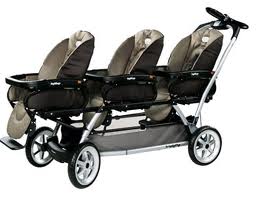
Tips on choosing a stroller for multiples

One of a multiple birth families most important pieces of equipment is a stroller to fit, two, three or more babies, and sometimes toddlers as well. It is also one of the most expensive items you will need. Investing in a good stroller is essential for several reasons:

    • multiple births families tend to use their strollers longer, i.e. not unheard of for the kids to be at least 4-years old. It can be because the babies were premature and therefore smaller at birth or because a parent has better control over where the toddlers might wander. If they can be securely fastened into a stroller this stimplifies the outing.
    • it is impossible to carry two or more tired toddlers, so having the stroller available ensures that all tired kids can be transported with a minimum of fuss;
    • a twin or triplet stroller gets A LOT of use and therefore needs to be of a good quality to withstand a lot of handling in and out of vehicles, and the bouncing of two or more active toddlers.
    • it is tempting to buy the cheaper stroller but keep in mind that your stroller will have to earn its keep transporting two, three or more infants and then toddlers.
    • Buying cheaper may find you 18 or so months later buying another one as the first one gave up the ghost.

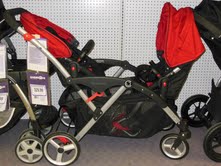
Multiple birthd - stroller 2     Multiple births -stroller 1

When considering a stroller, here are some important tips to consider prior to purchasing:

    1. Before making a decision, set it up and down in the store. The salesperson can assist in clarifying the oddiities of collapsing and setting up the stroler. Make sure that you can do it quickly and easily.
    2. Talk a walk in the store using your regular stride. Taller parents have been known to knock their skins on one which does not work well with their stride. Is the handle is too short? Hunching over while pushing a stroller will soon become a pain in the shoulders and back!
    3. Ask what is included in the stroller’s price. Not all strollers come with a rain cover, basket or sun roofs. Sometimes these cost extra.
    4. Double wheels can trap ice or rocks or swivel in opposite directions, making pushing it challenging. Larger, single wheels are an asset in Canadian Winters as they move more easily through snow and slush. It is helpful to know if wheels can be easily replaced if necessary. Ask how they clip on and off and how/where to purchase replacement wheels.
    5. Ask which parts, including frame, may have a replacement guarantee.
    6. A full handle length gives the pusher an advantage in controlling the stroller. The umbrella-style handles are sometimes set too far apart and making pushing them when the kiddies are on board a challenge, especially for shorter parents.
    7. Will it fit into the car? More than one family has pushed their new purchase to their car, a nd….it won’t fit in!
    8. There are pros and cons to each seating style of stroller:
    9. Side by side: Pros: allows you easy access to each baby/toddler when needed. The babies can easily interact with each other and most will fit through store doorways.
    10. Cons: The babies can easily interact with each other and as a certain stage, biting can be an issue or clunking of the other with a toy.
    11. Tandem (front and back seated): Pros: fits nicely through doorways and store isles.
    12. Cons: As the babies grow, it can be difficult to lift up over curbs and it may necessitate a trip around the front of the stroller to lift over a curb. It is impossible to quickly reach the baby fartherst from you in time of need. It is helpful to have the farthest seat positioned facing you in order to be aware of what that child is doing. When facing away from you, the child in front may constantly try to stand up to turn around in order to see what s/he might be missing.
    13. Some strollers are called “twin strollers” but in reality they are for a toddler and a newborn. The area for a newborn does not have adequate space for the legs of a toddler and the toddler area may not fully recline to accommodate newborns.
    14. There are wonderful joggers available for twins, triplets and more. If you like to jog, this may be the best stroller for your needs.
    15. Graduated seat heights make it easier to see each baby in the stroller.
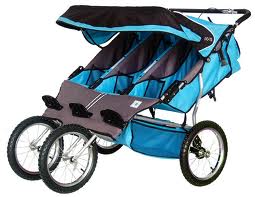
Stroller 1     Stroller 2

Now that you have made your decision, here are a few more handy hints from parents:

    1. If your babies are weight discrepant, rotate them with each stroller use so that the stroller wears evenly.
    2. Your stroller is an expensive item. By taking care of it properly, you can ensure that it’s resale value is high. Protect it against the elements and wipe it down if caught in the rain. If you bought your stroller new, it is well looked after (no rust or rips) and it is clean when offered for sale, you might expect to recoup one-half to three-quarters of your original purchase price, depnding on the make of stroller. Advertising through your local Twin and Triplet support chapter (here is a captive audience) will ensure a good resale price.
    3. As noted, expect to use your stroller for up to 4 years, especially if your babies were premature. When the children are older and get tired while on an outing, you will need a place to safely carry them, and the stroller is the perfect place. When they both (all) want to walk, it is a great place to put the diaper bag and/or purchases.
    4. A stroller is expensive but it does make a great collective gift for a Babies Shower or for relatives to get together to make the purchase. They are also available secondhand through local Twin and Triplet support chapters. Sometimes eBay has them for sale as well.
    5. If you need a quick repair for your stroller, check out the local bicycle repair shop. They are usually able to help out.

Places to look for twin, triplet and quadruplet strollers. These are some of the best Canadian Sites I could find. Please note that some sites come and go quite quickly. Happy shopping!

www.babyproofingplus.com
www.mountainbaby.com

….and don’t forget to check eBay and Kijiji. There are some amazing bargains!

Weaning Multiples

Weaning, in some instances, can be a challenge. When is the right time to wean? What if one baby is ready and the other(s) isn’t? What if two or three are and one isn’t? How can I make this as painless as possible and not feel guilty? What if nursing them settles them down and it’s the only way they will fall asleep? What if they are ready and I am not? Or what if I am ready and they are not?

Decide when you think it is time to consider weaning. You know your own situation best. The children could be 2 months, 10 months, 1 year, 2 years or anywhere in between. Reaching the decision may be because you need to go back to work, or it has been a year and you are exhausted with nursing combined with everything else needed doing. There may be pressure from others and having a plan to handle that pressure may be necessary. Nevertheless, think about introducing weaning slowly so that not only do the kids have a chance to learn the new routine, but your body can also make the necessary physical adjustment. Just as demand and supply increases milk supply, a reduced demand will result in less milk production. Slow reduction also allows for the physical relationship of Mom to babies and vice versa to change.

How to recognize when your multiples may be ready to wean

  • the kids themselves may be ready to give it up, but not completely and you would like to speed up the completion date;
  • maybe the kids are becoming disinterested in nursing and are self-weaning (it does happen from time to time);
  • weaning can be challenging when one is ready and the other isn’t. To add to the mix, the one whom is ready may continue only because his sibling hasn’t stopped yet. Multiples can become quite competitive if they feel their sibling(s) is getting something they are not; or
  • it could be that the opposite happens and one stops nursing and isn’t bothered that his/her sibling(s) continues to nurse.

Knowing one is ready to wean, may be the impetus needed to begin thinking along the lines of weaning all of them.

Suggestions for implementing weaning

  • changing the routine is a good place to begin. Drop the easiest daytime sessions first, or stretch out the time between daytime nursing with a distraction (story, trip to the park). You may still need to nurse at nap times;
  • try a sippy cup or straw if someone is thirsty;
  • a good rule of thumb, “don’t offer, don’t refuse;”
  • have a nursing song, perhaps ABC’s or slowly count to 20, to indicate the length of a nursing session. Be consistent so they know what to expect;
  • avoid areas of the house where they were nursed, e.g. sitting/lying on the sofa, their room, la-z-boy chair;
  • some children respond well to verbal interactions/preparations, e.g. big girls and boys use a cup;
  • you may only nurse them at nap/bedtime for a time;
  • when working on giving up the nighttime nursing, some Moms leave the house so that Dad, partner or grandparent can be the one to put the kiddies to bed. If Mom is anywhere in the house, expect to be found and there be a request to nurse. Staying out of the house ensures that someone else is the soother and comforter for the time being;
  • weaning, for whatever reason, may need to occur while the babies are still very young, e.g. 4 or 6 weeks. In such case, try not to switch to formula in one or two days. Dropping a few feeds each day will allow Mom’s body to respond to the decrease in demand and make weaning a more comfortable experience;
  • babies/toddlers nurse also for comfort so as weaning occurs, they are also looking to increase their other sources of comfort. This can take a little time to become the norm. Lots of hugs and physical touch is helpful.

Things to think about

  • never compare the children to one another, e.g. Look at Harry, he’s a big boy and doesn’t need to nurse;
  • be flexible, especially at the beginning. If one (two or three) is having difficulty letting go, be aware of each child’s individual needs and concerns. Being in tune to those needs will, in the long run, pay dividends;
  • stick with what works for a period of time until each child is comfortable with the change in routine, e.g. stretching time between day time nursing, no nursing during the day;
  • be prepared for setbacks. Tomorrow is another day and you can all try again;
  • don’t rush the process. Let the children tell you as much as possible what they need and when;
  • do not plan any huge changes in nursing patterns at emotionally stressful times: holidays, travel, having family guests, starting daycare, illness;
  • if you need to wean your babies because you are on medication, don’t stop cold turkey. Pumping from time to time will comfortably help reduce your supply;
  • for older toddlers/children, consider having a Weaning or Milestone Party to celebrate their growing up;
  • consider rite of passage changes to their bedrooms, changing cribs to Big Kid beds, moving out the rocking chair, and so on;
  • one inventive Mom put band aids on her nipples signifying that she had a “bobo”;
  • if you are receiving pressure from others indicating “it’s time,” gently stand your ground as to what you and your multiples need; and
  • speak to parents with older multiples and find out what worked for them.

Sources

Mothering Multiples: Breastfeeding & Caring for Twins or More, Karen Kerkhoff Gromada, La Leche League International, 2007

La Leche Leaque of Canada
www.lalecheleague.org

Additional Resources

Searching “breastfeeding multiples weaning” offers many helpful blogs.

These 2 books are not multiple-birth focused but they do contain helpful information about weaning. They are available on line through La Leche League:

  • How Weaning Happens , Diane Bengson
  • Nursing Mother’s Guide to Weaning , Kathleen Huggins and Linda Ziedrich

Lynda P. Haddon, Multiple Birth Educator, with helpful in put from Erin Shaheen, mother of multiples + more, and Kathy Litalien, Mom of twins.

Considerations when purchasing or borrowing car seats

As parents of multiples, it stands to reason that we will need several car seats. Many of us have other children as well, so car seats can be a huge issue.

The following has been put together to give you some hints to consider before you either purchase or borrow any used car seats in attempt to cut expenses. If you are in any doubt about the used car seat you are purchasing or borrowing, don’t do it. After all, your most precious cargo will be using these seats and they are depending upon you to help keep them safe.

NOTE: This information is provided as a set of guidelines. If you have any doubt about any used car seat, check with Transport Canada (contact information below) or the car seat’s manufacturer.

  • Car seatCar seats have carried a manufacturer’s date for some years now. The date is usually stamped on the manufacturer’s label on the back of each car seat. Make sure each car seat is not more than 10 years old. Our Canadian extreme temperatures, over time, break down the plastic in seats and, depending upon how old they are, they may not be as safe as when they were manufactured.
  • If a used car seat is 8, 9 or 10 years old, you may wish to pass onit as multiple birth children tend to use their equipment somewhat longer than a singleton child. In these cases, the ‘best by’ date is nearly past and you may not wish to have to repurchase newer seats at a later date, thereby doubling your expenses.
  • Each seat should have its manufacturer’s instructions showing how to install the seat into a car and how to correctly place a child into that seat. No instructions, then pass it by! If you are purchasing a new car seat, keep the instructions to go along with the car seat when/if you pass it along yourself.
  • Assess the interior of each seat. Are any of the straps worn, buckles missing? If yes, pass on the seat. Is the interior pad torn? If yes, consider the cleanliness of the car seat. Hygiene within a car seat, as well as safety, can be an issue.
  • Check the tether strap for forward-facing car seats, i.e. the strap that anchors the seat to the car frame. It needs to be in good condition.
  • Make sure you know if the used car seat has been in a car crash whether or not there was a child in the seat at the time of the crash.Even in the case of a minor accident, there could be stress fractures to the seat. If you can’t determine an accurate history for the seat, don’t risk using it.
  • If you have a car seat that has been involved in a car crash, even without a child in it, it is now deemed unsafe. Make sure that it is safely destroyed. Don’t risk putting it out at the curbside in case someone else picks it up to use. By the same token, NEVER pick up a car seat from someone else’s curbside.
  • Do notpurchase a new or used car seat manufactured in the United States. American seats do not meet Canadian safety standards.
  • Make sure to read Multiple Birth Canada’s Fact Sheet “Car Seat Tips” for other important information regarding car seats and your children. Learn how to assess when each child is ready to graduate to the next size car seat. Remember that each child may not be ready to graduate to the next size car seat at the same time.

FOR FURTHER INFORMATION ON CAR SEATS, contact Transport Canada at 1-800-333-0371 or visit their Website at www.tc.gc.ca/roadsafety/childsafe/notiavis/en/index.htm

When multiples are the bullies…

It is probably safe to say that all siblings argue, fight, and  bully one another.  You may remember your own battles with siblings.  Sibling arguments occur even in loving families. Arguments have an upside (although it is difficult to see any when the fur is flying and your ears are ringing from the taunting and screaming) and can offer fertile ground for learning to compromise, share, take turns, patience, and sometimes for the aggressors or bullies, to feel badly about their behaviour. Or not.

When children fight, a parent may step in for a variety of reasons:  escalation of the argument, things are getting physical (or dangerous such as throwing things) and someone can really get hurt, the fight has no obvious ending, or the fight is taking place during a car ride, making things dangerous and distracting.  A parent may try to mediate, teach compromise tactics or try to make sense of who did what to whom, and perhaps why.  If the argument began in another room or at school, there is no hope to truly figure out how things began.

When the aggressors or bullies are the multiples, things can really get challenging.  Because of the bond multiples have, they may “gang up” on younger, and even older siblings.  As a gang, they can be a force to be reckoned with.  It doesn’t seem to matter the multiples’ genders as they learn that as a group, they are more apt to be able to enforce their will.

sibling-bullying-thinkstock-100526086-617x416A twin Mom shares she has 10-year old twin boys, a 6-year old boy and 3-year old girl.  The 6-year old tries to emulate his older brothers and they, as a team, pick relentlessly on him causing melt-downs and chaos as a result, “you’re too small; you’re too young,” “such a baby” and so on.  They race ahead knowing their much-younger brother cannot physically keep up.  Younger brother does a lot of screaming, yelling and acting out while the two older brothers “look innocent.”

Another Mom of 12-year old twin boys shares that they relentlessly pick on and irritate their 8-year old sister.  The tears and resulting chaos make their home life next to intolerable.

A Mom with a 12-year old boy, 9-year old girl and 6-year old twin boys shares that even though their twins have a special relationship, they idolize their older brother and want to do whatever he does, giving him no peace.  When they have to go to bed before their older brother, the screams of “It’s not FAIR” reverberate off the walls.  With their combined reactive behaviour, the household is in turmoil.

In some cases, multiples will carry this “gang-type” behaviour into the classroom and school yard.   As a team, they can be formidable and the more they look alike (and are dressed alike?), the teachers may not be able to decide who is actually the culprit.  Punishing both, or all, may happen no matter how many were originally involved.

If these stories reflect some of what may be occurring at your house, there are some ways to deflect the gang-style behaviour and hopefully make it less likely to continue

  • first and foremost, congratulate yourself for reading this article.  You have recognized that there are issues in your household and you are attempting to rectify them.  Good for you!
  • avoid referring to the multiples as “the twins,” “the triplets” and so on.  This reinforces the package deal and in truth, they are individuals who happened to arrive together.  Use the children’s names at all times even when speaking to friends, family and peers to reinforce their individuality.
  • not dressing them alike is helpful to all so that they are not perceived as a package.
  • think about defusing the situation by giving the multiples their own rooms (if possible).  This action gives them less time together to scheme.
  • splitting up play dates, errands, sleepovers dilutes their “power” and helps them learn to separate from each other as well as  dramatically changes the family dynamics.  The bonus is that you get to spend time with each of your children in a completely different fashion.
  • try to put them in separate classes at school.  It will help each (all) develop their own friends and give them less opportunity to get together to collude.
  • foster a relationship between your other children if you have more than one other.  This relationship is also special and can become lost within a multiples’ relationship.  Even if they are different sexes, they can enjoy being and playing together.
  • set aside a “King/Queen for a day” day where each child gets to pick the family activities, chores, perhaps menu, outings.  Making each child feel special is great for self-esteem and learning patience until it is there turn to be in charge.
  • connect with other families in your area with children about the same ages as yours so that they can pair off and each have their own special friends.
  • reinforce common interests amongst all the children.  Depending upon their age ranges, it could be the park, colouring, skiing, skating, sports, music and so on.
  • look for at least one special skill in each of your children and help foster that skill, so that they will feel good about themselves and help them stand separate from their siblings.
  • give your other children the tools to handle bullying.  Screaming and crying only makes things worse. Providing tools to help control their environment empowers each child.  There are some good books and Web Sites to help you with those tools.*
  • making each child a part of the solution and not a part of the problem is not always easy, but is in the best interests of all.  With practice, positivity replaces the negativity and again, empowers each child.  No matter how small the good behaviour, focus on it and unless they are putting each other in physical danger, ignore the bad behaviour.  When one of the multiples is praised for passing the milk to a sibling for example, eventually that praise takes precedence and replaces the behaviour of refusing, ignoring or “you didn’t say please” type of behaviour.
  • realize that what is “fair” is constantly changing over time as your children grow and develop.   It will be affected  by the maturity level and capabilities of each child.  A later bed time, for example, may be negotiated and influenced by behaviour during the day, if it is a school night, and the age of the children.  Flexible and changing rules help children understand that some goals are earned and teaches them about negotiating and consequences.
  • try to keep calm.  Children, even young ones, pick up very quickly on the mood and tensions around them and will try to exploit it to their advantage.  It isn’t always easy but keeping calm, using a low voice, being consistent and working together as partners (i.e. Mom and Dad agreeing with how to handle the situation so the children can’t play one against the other) goes a long way to helping the children remember who is in charge.  If you are really angry about something that has just occurred, indicate, “I am really angry right now and cannot speak to you.  When I have calmed down, we will talk about what just happened.”  This statement lets them know your limits and boundaries, and rather than immediately flying off the handle and doing/saying something rash, taking the time to cool down and revisiting the issue at a later time is the wisest step to take.

RESOURCES

Books

  • Parenting School-Age Twins and Multiples, Christina Baglivi Tinglof, McGraw Hill, 2007
  • The Bully and the Bullier and the Bystander:  From Pre-School to High School – How Parents and
  • Teachers Can Help Break the Cycle of Violence, Barbara Coloroso, 2008


Websites

Googling Bullying turns up many helpful sites.  I am not listing any here because they change so often.

Birthday Parties: Planning those important birthday celebrations

The majority of us aren’t required to share our Birth Day with another family member and therefore get to revel in our own celebration with each of us at its centre. Such is not the case for children born on the same day.

If you are anything like me, that is non-creative and can’t bake to save her life, but feel birthdays are special, important and fun to celebrate, then you will appreciate the following ideas for celebrating your multiples’ birthdays.

Don’t limit the celebration to just these ideas – you are no doubt more creative than I – but making the day special for all (singles’ birthdays as well as multiples) of our children makes the memories last a lifetime. And don’t forget to keep the camera handy to record it all.

While some of these ideas will work for any of our children, the focus is on those birthday that are shared.

  1. Sometimes our babies are born on the either side of midnight or perhaps in different years, i.e. 31 December and 1st January. At least this way, everyone has their “own” day. You may consider two separate parties in this case or some families will do separate parties nevertheless, a week apart (or sometimes, two days following each other). I never found I had the stamina nor the inclination to subject myself.. I mean to organize, two separate parties. Important Note: For two (or three) separate parties, and depending on the natures of your children, you might need to make absolutely sure that each party, if held separately, does NOT in fact fall on one of their actual birth-days! This could open a Pandora’s box of fallout because one might feel that they had “one upped” their co-multiple(s), and we don’t want to go there!
  2. The first birthday is often kept fairly low-key and may be limited to family and close friends. We gave each daughter a cupcake for her first birthday and kept the camera rolling as they “dug in.” We still cherish the photos.
  3. I always made sure each child had her own cake – yes, there should always be ONE CAKE PER CHILD. This is so important for a couple of reasons: 1) Why shouldn’t they each have their favorite flavour? As impossible as it may seem, not everyone prefers chocolate; 2) With two (or three, or four) cakes, you can focus on each child individually – bringing in one cake at a time with lit candles and singing Happy Birthday for each child, singly. Each child needs to feel special on their birthday, even though they are shared. I broke this “rule” once in our daughters’ lives – I had to go a wedding on their 11th birthday and just couldn’t deal with the visitors in the house, getting ready for the wedding as well as making and decorating two cakes. I didn’t get about to baking a cake until about 3 and a half months after their birthday – and they particularly enjoyed reminding me of my failure. Heavily greased with a coating of guilt, I finally took a large, rectangular pan and divided the cake into two with icing, cross corner to cross corner. I iced their names and ages on the cake, we sang Happy Birthday twice, whipping the cake away in between to reset the candles and focus on the other child. Luckily my girls love to laugh and the opportunity to begin again, with the same cake, provided us all with some jocularity and good memories.
  4. You may have gathered by now but in case I wasn’t too clear, I prefer One Party. I just didn’t have the energy for two parties and truly admire those who will go to the lengths of preparing two separate parties. Nevertheless, we did have really neat party themes. One year we had a Tea Party using their toy dishes. We had applejuice, grape juice and various flavours of Kool-Aid ‘tea’. I made teeny, tiny sandwiches and cookies, to fit the small plates. Everyone could serve themselves and were thrilled at playing grown up. Note: Use a white, double sheet for a table cloth. It doesn’t matter if stuff is spilled and goes right into the washing machine. Oh yes, and everyone came in their best dress up clothes. You might pick similar themes for the party for boy/girl combinations, say Bat Man and Wonder Woman or G.I. Joe and Barbie. Once again this allows a focus on each child but within the same party context, on the same day! ?
  5. We always had each child sit at one end of the table, surrounded by the invitees of their choice. This, too, allowed for the focus on each child individually.
  6. For other party ideas and depending upon the ages and interests of your children check out the following in your local community (most of these places will do everything for you, including loot bags): Wave Pool, Cinemas, Community Centres, YW/YMCA, Athletic Clubs, Museums or Library. You can “rent” Magicians, Clowns, “Scientists”, and Reptile Specialists (unless these are off limits for you ?). On our girls’ 13th birthday, they each invited one friend and we went White Water Rafting. My husband took the day off work and we had a trip to remember. It was not only a wonderful experience, but also a great family outing.

Individual, Happy Kids: Priceless!

Have you got Birthday ideas that worked for you or Birthday photos and you would like to share them?  Please send me a note and I will be pleased to add them to the list.

Grieving Grandparents

One of the most overlooked areas of grief is the grief experienced by grandparents. Your child has just suffered the death of their child or children and you could not protect nor shield him/her from this devastating loss. Further, you have lost your grandchild(ren). Your own hopes and dreams for the future are shattered. To further complicate matters, the grief process is a long, often painful journey which has no timeframe and which is very personal. There is no right or wrong way to grieve, only your way. With the loss of a baby(ies), we are changed forever. Hopefully the following will assist you, as the Grandparents, in coming to terms with and handling not only your own grief journey but also that of your child.

It is natural to want to protect one’s child from pain but that is not always possible. As you watch your child suffer and the dreams for the future are shattered with the death of your grandchild(ren), you can only stand by and watch. You feel powerless. It is difficult to offer comfort when you are also grieving yourself. You must try to offer comfort at the same time as you grieve.

  1. Take your child in your arms. Hold them, cry with them. Let them tell you how they feel. Listen with your heart, soul and with love. Words aren’t particularly necessary as you hold, support and love each other.
  2. If you are able to share some of your own feelings of sadness, do so. When we share difficult moments together, it makes the burden a little lighter. Concealing your own pain or feelings may only make them feel that you don’t care.
  3. Try to avoid telling your child how they should act. “You can have another baby.” “Try to pick up the pieces and get on with your lives, you are young.”
  4. If at all possible, try to see the baby(ies), to hold him/her, take photos with everyone, name the baby(ies). Encourage your child to do the same. Do not be afraid to use the baby’s name. After all he/she existed and was a real part of your family’s fantasy and future. To ignore the pregnancy or the loss will only make the mountains higher.
  5. Remember that the loss of this baby(ies) is not your fault. You did not cause the baby(ies) to die, but you can be supportive and available when possible to do so.
  6. Do not feel badly if your grief is initially ignored. As the parents try to come to terms with a new reality, they may inadvertently exclude you and not recognize the depth of your grief.
  7. Avoid blaming: “Do you think you exercised too much? Or drank too much coffee?” You might ask, “I know I wonder if I could have done anything differently, do you have similar feelings that are bothering you?” Try not to judge nor interpret any responses.
  8. Take care of yourself. Make sure you eat nutritiously and that your child and their partner does too. One of the first things that falls to the side after a death is appetite. A snack of cheese, fruit or vegetables ensures that health and strength are kept up. Try also to get adequate sleep and exercise during this painful period.
  9. Try to keep the lines of communication open between family members. Offer to assist with meals, childcare if there are other children, share resources and books.
  10. There are things that you can do to celebrate the memory of your grandchild(ren):-
    • plant a garden or a tree in a local park;
    • do some volunteer work;
    • make a donation to a favorite charity;
    • write about your feelings and perhaps give the journal to your child at a later date;
    • do something special on anniversaries or birth/death days.
  11. Grief is a very powerful emotion. Remember your other grandchildren if you have them. Don’t let your grief overshadow your ability to interact with them or others.
  12. If your child and spouse feels comfortable with it, you may wish to include the child(ren) who died whenever speaking about your grandchildren, especially when mentioning how many you have.

One bereaved grandmother advised that she was told by her son and his wife (both doctors) that she must never refer to the babies again (they died at 5-1/2 months gestation). This grandmother felt blocked and ignored regarding her own feelings. She felt that being doctors, they should be in a better position to understand grief, loss and how to deal with them. This is not always the case and while no doubt being able to dispense wise advice to their patients, were not able to acknowledge their own pain and loss. Denial regarding their loss was also inflicted on the grandparents. If such is the case for you, join a bereavement support group, try some grief counseling or speak to a good friend, doctor or religious support person. You don’t have to go through this alone. Your feelings are real and painful. You, too, have suffered a loss but you may need to explore some avenues on your own in order to obtain appropriate support.

Other Resources

Grieving Grandparents, by Sherokee Ilse and Lori Leininger, Wintergreen Press Inc.

Loss Organizations

Loss Support Network, Multiple Births Canada, www.multiplebirthscanada.org

Centre for Loss in Multiple Births (CLIMB), Alaska
E-mail: climb@pobox.alaska.net

Trying Again After Loss

By Ann Douglas and Lynda P. Haddon

It takes courage to try again when your previous pregnancy has ended in miscarriage, stillbirth, or the death of an infant(s). You know that there’s a chance that you may experience another loss, but you’re willing to risk it all for a shot at the ultimate prize: a healthy baby(ies) that you can call your own.

As committed as you may be to having another baby, it’s perfectly normal to feel a bit nervous about planning another pregnancy. After all, you already know that not all pregnancies result in picture-perfect happy endings. Like it or not, the innocence that you enjoyed when you found yourself pregnant for the very first time is gone forever. You can’t get it back.

Don’t be surprised if you find yourself experiencing a smorgasbord of different emotions when you first make the decision to start trying to conceive – everything from joy to worry to outright panic. Some days, you may feel convinced that becoming pregnant again is the only thing that will bring joy back into your life. At other times, you may wonder if you’re crazy to even think about exposing yourself to the possibility of heartbreak again.

You may also find that your partner has mixed feelings about trying again, whether or not he’s actually willing to express these emotions to you. After all, he’s not just worried about the well-being of any future babies you may conceive: he’s also worried about the impact of any subsequent losses on you as well as dealing with his own feelings of loss, helplessness and grief.

If you’re having difficulty deciding whether or not the two of you are actually ready to embark on another pregnancy, you might find it helpful to consider the following questions:

  • Have you both had a chance to work through some of your grief for the baby or babies who died? Grief can be an exhausting emotion – one that demands far more of your time and attention that you want to give it. Grief is unpredictable and can come to the fore with previously unknown and unplanned stimulants. If your baby(ies) died recently, you may still be going through a very rough time emotionally and you may not be able to embark on another pregnancy just yet.
  • How would you cope if you were to experience fertility problems? If you don’t think you’d be able to weather the emotional highs and lows that couples typically experience when they are having trouble conceiving, you might want to postpone your baby making plans a little while longer. While the fact that you managed to conceive in the past means that you have an excellent chance of conceiving again this time around, you have, at best, a 20% chance of conceiving in any given menstrual cycle. That means the odds of being disappointed during the first month or two of trying are extremely high. Are you emotionally strong enough to cope with that disappointment?
  • How would you cope if you were to experience the death of another baby(ies)? While you may not want to even consider this possibility, it’s important to go into your subsequent pregnancy with your eyes wide open. If you’re still feeling emotionally fragile, it may be too soon to jump back into the fire again.
  • How would you cope with the stress of a subsequent pregnancy? The worry doesn’t end when you manage to conceive. If anything, it’s just beginning. That’s why it’s important to be sure that you’re up to coping with the stress of what could very well be the most nerve-wracking 40 weeks of your life.
  • Are you expecting too much of your subsequent pregnancy? If you expect a new pregnancy to wipe away the grief you are feeling for the baby or babies you lost, you are setting your expectations too high. No other baby can possibly take the place of that other baby in your heart. We are different people than we were before our loss. We can learn, however, to place our grief in a place that permits us to move forward with our lives, albeit forever changed.
  • While losing one more or all of multiple birth babies carries its’ own unique issues, it is important to have tried to come to terms as best as possible with these issues while considering another pregnancy. There is the loss of a unique parenting style. Parenting a singleton child is very different from parenting twins, triplets, quadruplets or more. While pregnant with these multiple babies, fantasies run high as we proudly show them off to friends and families, walk and bathe them in our minds before birth. In our mind, we may even have struggled with how to get the triplet stroller into the car. This unique parenting style is lost when the multiple birth pregnancy changes.
  • Have you considered the possibility of another multiple birth? When multiple birth babies are conceived “spontaneously” or without fertility assistance, there is a marked increase in your chances of conceiving multiples again in subsequent pregnancies. Your age is a facilitating factor as is if you have already had several children. It isn’t unheard of to have multiples again after loss. And, of course, those using fertility assistance will also increase their chances of a repeat multiple birth. Consider the family who lost triplets at 22 weeks and then became pregnant with triplets again and carried successfully. Or the family who lost a twin then successfully delivered twins again 18 months later.

One mother who lost twins and found herself pregnant again six months after their loss had some important feedback for others. She noted that she and her husband had difficulties marking the first year anniversaries that arise after a loss: Father’s Day, Mother’s Day, Birth/Death Day, Christmas, etc. while being pregnant with a new baby. While their new baby is a much wanted Treasure, she advises that parents need to be aware of possible conflicting feelings about being pregnant at the same time as dealing with loss emotions around the anniversaries of losses. These unexpected emotions took them completely by surprise.

In addition, Mom noted that as her subsequent pregnancy inadvertently followed one year later the time line of their lost pregnancy, they became aware that they could have been preparing for a birthday party for two two-year olds rather than celebrating an upcoming first birthday for a singleton. The family was aware that but for their loss, their lives would have been totally different and they needed to work through their feelings in this regard.

While there are a lot of factors to weigh in deciding whether or not you’re ready to start trying to conceive again, your best bet is to listen to your heart. Most couples instinctively know whether they’re ready again or not. Consider these words of wisdom from Cynthia, 35, who experienced a series of miscarriages before giving birth to her second living child last year: “If you have to consciously decide, then it’s probably the wrong time. It’s kind of like being in love. You always wondered how you would know when you were, but when you were, you just knew it. I think it’s the same. When you’re ready to try, you’ll want to try. It’s really that simple.”

Ann Douglas is the co-author of Trying Again: A Guide to Pregnancy After Miscarriage, Stillbirth, and Infant Loss (Taylor Publishing, October 2000) and The Unofficial Guide to Having A Baby (IDG Books, 1999). Ann has written over 30 books, many addressing a wide variety of parenting issues. She is the mother of four living children as well as Laura, who was stillborn in October of 1996 as the result of an umbilical cord knot. She can be contacted via her web site atwww.having-a-baby.com

Lynda P. Haddon has been working extensively with multiples and their families for over two decades. She has three grown daughters, including dizygotic twins. Her first pregnancy ended in miscarriage. Lynda has spoken on several occasions to healthcare professionals regarding the unique issues of loss in multiple birth. Lynda has been Chair of the Loss of Multiples Support Network for Multiple Births Canada for 15+ years and has been providing support and assistance to bereaved multiple birth families for over 20 years. She has also revised and revamped Multiple Births Canada’s three Loss booklets and written many articles on various aspects of loss in multiple birth.

Holidays and Grief

Holidays and grief are often inevitable after losing a baby. There will be several times during the year which are very difficult for bereaved families – birthdays, anniversaries, weddings, to name some but probably the most difficult holiday will be Christmas. Automatically the mind conjures up ‘family’, presents, food, noise and a festive air! For bereaved families, this can be a very difficult time of year.

The following are some ideas that may assist you through stressful milestones and special occasions.

  1. SIMPLIFY! Christmas Holiday stress, even in good years, is from the long list of ‘have-to-do’s’. Reexamine your priorities to begin some new, healthier traditions. Only attend parties you feel are truly important. Ask family members to exchange gifts only for children in the family rather than the adults (or encourage them to make a donation in your child(ren)’s name to a meaningful children’s charity, POMBA Canada or CLIMB, for example. Stop shopping for the adults in the family who probably already have everything they need. Consider not sending cards this year.
  2. Do things differently than your normal routine. Attend your religious service at a time other than you would have normally. Visit your relatives rather than having them visit you. Or, you may take a vacation over this time period.
  3. Begin to build a pleasant time with family and friends. Don’t feel guilty if you do have a good time.
  4. Make sure that there is a balance in your life – eat, sleep, rest, pray, read, work and relax.
  5. Responding to happy greetings can be difficult. To a “Happy Holidays” wish, you may respond, “I’ll try” or “the same to you!”
  6. Do some volunteer work in the name of your child(ren). Visit someone who is unable to get out, make a donation or send flowers in your child’s name.
  7. Light a special candle in remembrance to your lost child(ren).
  8. Donate a new toy or clothing to a children’s shelter.
  9. Try to keep in mind the feelings of your other children and to make it as joyous for them as you possibly can. Speak freely to your family members of what you feel capable of coping with or being involved in.
  10. You may wish to keep a journal of your thoughts at this time, or even as a letter to your lost child(ren).
  11. There is no right or wrong way to handle the day. You may feel ‘safer’ following family traditions or you may wish to begin some new ones or just to deviate for the time being. Your wishes can change year to year.
  12. It is best to try and do what is most helpful for you and your family. If a situation looks especially difficult over the holidays, try not to get involved.
  13. Try not to imagine the future. Take one day or even one hour at a time.
  14. Allow yourself time to cry, both alone and with your loved ones.
  15. Some hospitals may allow you to hang an ornament for your child(ren) on their tree.
  16. SHOP EARLY! Don’t leave it to the last minute and end up feeling overwhelmed.
  17. Holidays and special occasions magnify feelings of loss. It is natural to experience the sadness that these occasions can bring. Try not to block these feelings as it is unhealthy. A good cry to release built-up sorrow can leave you better able to face your day-to-day holiday stress.
  18. Hold onto HOPE! – the anticipation of the holiday is often worse than the actual holiday. Future years will most likely bring some healing and ability to enjoy this time of year again, in ways that are hard to imagine when you are weighted down by sorrow.

Adapted From

  • How to Help Ourselves Through the Holidays; Bereaved Families, Ottawa
  • Canadian Foundation for the Study of Infant Deaths.
  • With contributions by: Elizabeth A. Pector, M.D.

Suggestions for What to Do With the Baby Shower Gifts and/or Nursery When the Babies Have Died

A frequently asked question is what to do with Baby Shower gifts and/or Nursery when the babies have died.

The following suggestions are offered in order to provide some ideas as to how to handle this situation. Be sure to choose something that works for the both of you.

  • If you don’t want to keep the gifts for your next pregnancy, then return them assuming the persons giving you the gifts want them back. It may be that some want them back and some do not.
  • If the person giving you the gift does not want their gift back and you do not want to keep it because things have changed dramatically and you don’t wish the painful memories, consider donating each to a worthy cause, e.g. a women’s shelter, hospital, immigrants’ shelter. Some communities have homes for unwed mothers and they are very grateful for baby gifts. You could write each gift giver a short note indicating that their “very special baby gifts” have gone to such-and-such a cause in honour of your own special babies.
  • Consider keeping one, two or more (one for each baby) of your gifts, e.g. stuffed animals, for your babies’ Memory Boxes.
  • It may be that you have received special, expensive gifts which you don’t feel comfortable keeping. For example: Royal Doulton baby dish sets or snowsuits. Call the people who gave you the gifts and ask if they would like them returned. Take the opportunity to let them know of your idea to donate the gifts and let them know which place you have in mind. They may agree to having their gift donated as well. A phone call asking specifically for feedback when you are not sure what to do, will help decide on a mutually acceptable course of action.
  • A gift is a gift, regardless. The generous spirit of giving shouldn’t change if the babies die. When a gift is given, ownership of that gift is transferred. If you don’t feel you want to return the gifts or even some of the gifts, it wouldn’t be incorrect but you may still feel conflicted. If you are in doubt ease your mind by calling the giver.
  • Take your time when deciding what to do with the gifts. Initially, you may be taken up with mourning and funerals. Don’t be pushed by well-meaning relatives or friends to decide too quickly what to do with the gifts. If you are pushed to make a decision, it could add additional stress. Give yourself a few months to complete the task. You may disperse the gifts with your partner or you may ask a close family member or friend to help you.
  • The same with taking apart a Nursery. Many families set up a babies’ room ahead of time. There are no hard and fast rules on how to handle it. You might ask family or friends to take it down and store it before you come home from the hospital or you may wish to do it yourselves. If the latter, close the door and enter the room only when you feel ready to do so. You could move the cribs, equipment and toys to the basement or put them in storage so they will be out of your sight and you won’t fear tripping over them and triggering painful memories. It isn’t terribly expensive to do the latter. You may also choose to leave the Nursery for your next pregnancy. WHATEVER YOU CHOOSE TO DO IS RIGHT. Don’t be talked into anything that you feel might not work for you.

If you have any suggestions that you would like to see added to this list, please write to me and let me know.


Do We Still Have Triplets?

The triplets were born at 29 weeks gestation, at about 2-1/2 lbs., 2 lbs. and 2 lbs. respectively. At ten days old, the eldest and largest succumbed to complications due to his prematurity. The parents were, naturally, devastated and the father asked me, “Do we still have triplets?” Without even hesitating, I answered, “Yes, your babies remain as they were conceived and you are still the parents of triplets. Nothing can change that. The difference is you have two on Earth and one in Heaven.” This makes perfect sense to me.

To call these precious babies “twins”, from this point forward, is not correct for a couple of reasons: 1) three babies were conceived and three babies were born. To call them “twins” denies the short life of a precious, much loved and wanted child, and 2) the simple truth is the two living siblings are surviving triplets and not twins at all!

The question, “Do we still have twins (triplets? quadruplets? multiples?)” is one of the most common questions from parents who have lost one or more of their multiple birth babies. Those working with multiples and their families or whom are bereaved parents who have conceived multiples and lost one or more, have no difficulty in understanding that surviving children remain twins, triplets, quadruplets or quintuplets. Making others understand such a concept, can be an enormous challenge. Sadly, some of the most painful denials come from family members.

One mother who delivered premature twins and one succumbed some 10 hours later due to birth anomalies, tearfully explained that her mother-in-law never mentions their deceased daughter. Her mother-in-law did not attend her granddaughter’s funeral and, four years later, continues to celebrate the birthday of her “’singleton’ granddaughter.” In addition, this same mother received a card from a co-worker reading “Congratulations on the Birth of your Daughter” even though her co-worker was fully aware she had been carrying twins.

This mother was inconsolable as she recounted her story. These are enormous hurdles for any parent to face: their grief has not been recognized; their daughter’s life has not been recognized or acknowledged, and Mom has not been given “permission” to grieve by either her mother-in-law or co-worker. She remains confused as well as very hurt and angry that her twin daughter’s life, albeit a short one, is completely denied. Mom would love nothing more than to talk about the loss of her child and the future that would have unfolded. While she and her husband feel that they are the parents of twins, others do not understand or share the same point of view and no doubt due to their own inadequate feelings around death, especially that of a child, choose to ignore the loss and celebrate the life of a “singleton child.”

This kind of situation is a very difficult for any family to have to deal with and, unfortunately, not all that uncommon for parents with surviving multiples. Not only is the birth and short life of their child (even if only in utero) denied, but the parents are not provided a safe place to share their sorrow in surroundings with people who understand and care about them. These parents are not “permitted” to acknowledge that they lost a child as well as a unique parenting experience, nor that their surviving child(ren) has lost a unique sibling relationship. The message given to many such bereaved families is that they must “carry on.” Research has also shown that in such situations, parents suffer compicated and prolonged grief when their loss is unrecognized by the people closest to them (Patricia Swanson, et al.).

Children are not interchangeable. Each and every child is important, no matter how short their stay with us. Hopes, joy, dreams, love and future planning are tied up in awaiting the birth of a child and dramatically affected when those dreams are brutally cut short. Parents with surviving multiples have the burden of extreme feelings, both at the same time: Joy at the birth of their child and Despair at the death of their child.

Whether or not parents wish to divulge their personal history will depend upon the situation they are in. With extended family or good friends, they may be open about the loss of their baby(ies). With strangers at the Mall, the parents of two surviving triplets may choose to just let comments pass, “Oh, how wonderful. You have twins!”, or even, the very painful comment “Be thankful you didn’t have triplets.” Which ever way you choose to handle the situation is the right way.

There is no doubt in my mind that the above mentioned family still has triplets, two with them here on Earth and one in Heaven.

Lynda’s Note

Many thanks to Dr. Beth Pector for her feedback and input on this article.