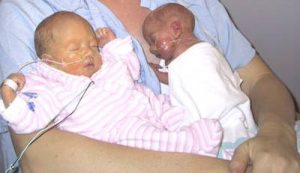
A Successful Breastfeeding Experience: PRICELESS!

An interesting breastfeeding issue sporadically presents itself over my desk in a variety of ways: from new breastfeeding parents (those new babies are doing the breastfeeding, not the parents….LOL), friends with multiples, and several participants in the Ottawa Twins Plus Prenatal Classes which I co-faciltate in Ottawa. Dismay and feelings of insecurity abound when family, friends and professionals, including doctors, nurses and pediatricians, offer opinions which, even inadvertently, can sabotage breastfeeding in spite of the babies growing by leaps and bounds and a satisfying breastfeeding experience.

In this day of enlightenment about the benefits of breast milk, one wouldn’t think that such would be the case but I am surprised – no, make that saddened – by how many parents share their frustration and confusion as a result of such feedback. Parents are left questioning their motives and wondering if they should stop breastfeeding. It doesn’t make sense that negativity can be attached to a successful experience, but parents are telling me that that is exactly what is happening.

Here’s an example:  Kathy’s babies were born at 25 weeks and a couple of days. Kathy, with her husband’s full support and encouragement, copious amounts of milk for her sons until they were able to go directly on the breast. At 5 months, they were round, happy, smiling, very content little boys and Mom had an appointment with her sons’ female pediatrician. At this check-up Mom was told, “Breastfeeding is going very well at the moment, but expect to have to supplement at some point.”  Mom left the appointment with many different feelings, including sad, fearful, and upset in spite of how well her babies were doing.

The doctor might as well have said, You are all doing really well, but don’t expect this success to continue.”

One doctor reportedly indicated to a Mom pregnant with twins, “You are not superwoman. Just bottle feed.”

“You can’t breast feed twins,” was my own experience from a nurse in the Neonatal Intensive Care Unit.

Add to the mix comments from family and friends and one’s confidence can barely remain intact: To one family with 3-month old twins where breast feeding was also going very well. “When are you going to stop breastfeeding?”

A variation on this theme goes:  “Surely you are thinking of stopping [breastfeeding] shortly?”  It isn’t unusual to breastfeed a singleton child for up to two years, so why would things be different for twins, at least beyond 3 months?

Or how about, “You can’t be exclusively breastfeeding. Surely you are supplementing.”  And how about the twin Mom whom had planned all along to breastfeed her babies but was encouraged by the hospital staff to take home 2 cases of formula when they left the hospital.  Talk about frustrating, discouraging and confidence-shaking!

Twins and triplets were born and survived in the many hundreds of years before now. If there was no formula around before the last, say 55 years, just how did these babies grow and thrive if they weren’t breast fed? Many of us have multiple-birth relatives over the age of 55 years. How does anyone think they were fed? Even taking into consideration that royalty and upper classes usually hired Wet Nurses (i.e. lactating servant women hired to breast feed their babies as well as their own – rather like breastfeeding twins……), we can rest assured that many less well-off families could not afford to hire a Wet Nurse and therefore successfully breast fed their own babies, no doubt for months if not years. So why has the current view changed and the opinion prevails that breastfeeding our babies, let alone for weeks or months, cannot be done today?   It’s all quite thought provoking and in fact, this shift in thought doesn’t make a lot of sense at all.

A suggested solution is to use the situation as a teaching experience. Rather than responding angrily, or zapping back with a tricky ‘slice and dice’ phrase, how about changing tactics?

We know we are left feeling upset by such confidence-shattering remarks, and a successful breastfeeding experience doesn’t guarantee we won’t get stung, so let’s take back our power, point out the logistics, and hand back the hurtful and negative opinions. Let’s regroup and get these folks doing some serious thinking before they open their mouths with thoughtless rhetoric. Here are some ideas for consideration:

  • When the decision has been made to breastfeed, reinforce the decision when (if) necessary.  Make eye contact, perhaps hold up a hand, say,“Excuse me, but we have decided to give our babies the best beginning we can and breastfeeding is what we have chosen to do. We really appreciate your support in our decision.” and Smile!  End of story.
  • If a professional makes an unsettling remark, quietly but firmly call him/her on it. ” I’m not understanding what you are saying. You have acknowledged our breastfeeding is going well and the babies are thriving and yet you throw in that our success won’t/can’t continue. I beg to differ. It is possible to breastfeed multiples because breasts adjust to the supply and demand and I’ve got two perfect examples right here! (you can either point to your breasts or to your babies – whichever suits you)” ….and Smile!
  • A remark such as “Surely you will stop breastfeeding soon” might encourage the response, “We will stop when we are ready.” and of course….Smile!
  • And the one about not being Superwoman, how about, “I disagree. I AM Superwoman and my babies are going to have the best start possible with my Super Breast Milk.”   And everyone together now…..Smile!

Offering educational feedback and speaking up is a way to ensure change. It is so upsetting to hear from parents who not only love their children and are doing a great job breastfeeding, but to learn of their uncertainty as they begin to question their motives and ask themselves, “Am I really doing the best thing for my babies?” especially after the powers that be offer failure for the future.  You can set the record straight and perhaps give the next multiple-birth family an easier ride. Speak up, gently express your feedback, set your boundaries and let others know how you feel about their comments. As Martha would say, “That’s a good thing.”

May your breastfeeding go well and your babies grow, develop and flourish. When you are faced with the necessity of teaching others about breastfeeding multiples and how to treat you, may you rise the challenge with humour, confidence and love.

Nutritional Guide for Multiple Birth Pregnancy

Food Group
Milk and milk products
Breads and cereals
Fruits and vegetables
Meat, fish, poultry and alternatives
Number of Daily Servings
4-6
8-12
6-10
2-3

Please refer to Canada’s Food Guide for information on portion sizes.

Use in moderation: Fats and oils (example: butter, margarine, salad oils)

This nutritional guide will provide you with about 2000-2600 calories. It meets the nutrient needs for the second and third trimesters of the average, healthy woman expecting twins or triplets. The foods listed here are to guide you only, as the needs of each individual will vary. If this is not enough food for you, more servings can be selected from the food groups. Small, frequent meals, with snacks, may help you eat the larger volume of food and aid with the control of heartburn.

Following are some sample Menus which incorporate foods from the Canada Food Guide for a Multiple Pregnancy.

Breakfast
1/2 grapefruit
Shreddies and Milk
Whole wheat toast with margarine
Supper
Pasta
Tomato meat sauce
Grated cheese
Steamed zucchini or broccoli
Milk pudding
Lunch
Baked beans or chicken leg & bread, margarine
Spinach and Tomato Salad with salad dressing
Banana
Milk
Snacks
Yogurt
Bran muffin
Cheese and crackers
Hard boiled egg
Fresh fruit

Adequate fluids are important and 6-8 glasses of fluids per day are recommended. Alcohol should be avoided and caffeine consumed in moderation (e.g. coffee, tea, chocolate, soft drinks)

You will need an iron and folic acid supplement for your multiple pregnancy and these are prescribed by your doctor. Your doctor, dietician or nutritionist can advise if there is a need for further vitamin supplementation and if so, which ones.

Salt (sodium) should not be restricted. Moderate amounts may be used at the table or in cooking.

WEIGHT GAIN FOR MULTIPLE PREGNANCIES

Studies have shown that women who gain 26-35 pounds (16-21 kg) with their twin pregnancies, have healthier babies. The weight gain pattern for twins and a singleton in the first trimester is the same. You can expect to gain 1-4 pounds (0.05-2kg). In the second and third trimesters, you can expect to gain about 1.5 lbs. Per week (0.75kg). By 24 weeks gestation, you will likely have gained 24 pounds and by 32-36 weeks, 32-40 pounds.

REMINDER: All weights noted are suggested amounts recommended for the average, healthy woman.

Triplets and Quadruplets: A suggested weight gain for a triplet or quadruplet pregnancy has not been documented. However, one could deduce that a triplet suggested weight gain should slightly exceed that of a twin pregnancy, while a quadruplet weight gain be slightly more than the triplet pregnancy.

NOTE: When weight gain is too low, it could negatively affect the outcome of a pregnancy. Low weight gain affects the hormonal response to the pregnancy and therefore limits intrauterine growth. It is recommended that if any point in your multiple pregnancy you should feel that you are unable to eat one of the good groups, or are not sure whether you are eating properly, whether you have sufficient vitamin supplements or are unable to gain the recommended weight, ask your doctor for a referral to a dietitian.

Adapted and Compiled From:
Canada Food Guide

Nutritional Guidelines for a Multiple Pregnancy, by Pauline Brazeau-Gravelle and Julia Watson-Blasioli, printed by the Ottawa General Hospital; May, 1997

Calgary Foothills Hospital, Clinical Nutrition Services.

One is Alive, One is Not

Please note that the information contained herein is general in nature and does not cover every possible situation.  If you have concerns about any aspect of your pregnancy, please consult your doctor.

For many months, you have delighted in carrying your precious babies beneath your heart.  They are very active and your belly grows almost daily.  Beating hearts have been visible on the ultrasound screen as perhaps have legs, arms or spines, depending upon which way they are lying.  One of the babies though is smaller (usually referred to as small for gestational age) and a little weaker than his co-multiple(s).

Then the unthinkable happens: the smaller one has passed away.  It is still early enough  in the pregnancy that it needs to continue for several more days, or even weeks, to give the survivor(s) the best chance at survival outside the womb.

This unbelievable and devastating situation is almost too much to absorb, let alone comprehend.  Shock as well as many questions leap into the parents’ minds in an attempt to understand what has occurred and why.  Following are some frequently asked questions:

Q: What is going to happen to my surviving baby(ies)?

The death of a multiple before 16 weeks of pregnancy generally creates no increased risk for the remaining baby or babies.  An after 16-weeks death of a multiple with a separate placenta from the other(s) is also not too likely to cause any problems.  When a deceased fetus’s placenta is shared with a co-twin (monochorionic), there is some risk of problems for the survivor, but not always.  With the death of a fetus when there is a survivor(s), the mother can expect to be closely monitored until birth. Your doctor can discuss your particular situation and explain a management plan for your pregnancy until birth.  While the mental strain can be very taxing, many women continue their pregnancy and have a healthy survivor(s).

Q: Will my dead baby hurt my living baby(ies)?

If the surviving multiple(s) is healthy itself, there will be no affect on the living baby(ies).

A deceased baby’s body begins to be broken down in utero and is reabsorbed by the mother’s body and/or the survivor’s placenta.  Depending upon how long after death it is delivered, depends upon what its appearance will be like when it is delivered.   Delivery can be expected to be earlier than previously planned if the babies share placentas and/or sacs.  Mom is carefully monitored until birth, so that the doctors can make timely decisions if needed.

Q: Did my baby ‘kill’ his sibling?

No, one baby didn’t ‘kill’ the other.  The deceased fetus usually has substantial health problems through no one’s fault (e.g. anomaly within a larger organ such as the heart). Through ultrasounds, it is sometimes possible to diagnose that one baby is weaker and has a compromising health problem(s).  In twin-to-twin transfusion syndrome (with monozygotics), for example, the mother is closely monitored to try and prolong the pregnancy as long as possible in order to give both (or all) babies the best chance.  With some medical issues within the womb, however,  it isn’t always possible to successfully intervene and one baby dies.   Sometimes the death cannot be explained until the baby and the placenta can be examined after birth and even then, the reason for the death may not be identified.   Depending on when a fetus passed away and how many days or weeks later the mother gives birth, it is not always possible to identify the cause of death due to deterioration of the fetus and/or placenta.

Q: How is this going to affect my own health and emotions?

Physical complications for the mother after one multiple dies in the womb are uncommon. Careful monitoring of both mother and surviving baby(ies) during the rest of pregnancy can detect any signs of concern.   Delivery may occur earlier than previously planned because of this changed situation.

Emotionally the situation can be quite different.  Some women report feeling fear, isolation, confusion, devastation or horror.  Some report feeling particularly close to their dead multiple because they know this is the only time they will have him/her. They report a great sadness through the rest of pregnancy, unable to find any joy in the approaching birth because they will need to give up that baby. Others push grief aside, fearing it will harm the remaining child(ren) or cause preterm labor. They dedicate their energy to hopeful thoughts about the survivor(s).  Some hang on to a belief that there has been an error and at delivery, there will be two (or more) healthy and alive babies.  All of this is normal.

Q: What will the delivery be like?  What will happen?

Your doctor, hospital staff and grief counselors can help you plan a birth experience that honors your deceased child while meeting the medical needs of your living baby.   Depending upon at which stage the baby died, you may need a death plan as well as a birth plan.  Communication with your doctor about the delivery will help clarify what will happen and how things will proceed.  Don’t be afraid to discuss with your doctor your needs and fears.

Q: What will our dead baby look like at delivery?

Your baby’s body will be small (as compared to its co-multiple[s]) but recognizable as a baby if death occurred after the 14th week of pregnancy. There will likely be some distortion of features and discoloration (bruising).  Discussion with your healthcare provider or a grief counselor can sensitively prepare you for your baby’s appearance, and help you choose whether to view him/her after birth or not.   Some families choose to view their baby regardless, some don’t want to view the baby.  Don’t be pressured into doing anything that you don’t feel comfortable doing.  Whatever you decide to do is what is right for you.  You may wish photos to be taken either by yourselves or ask the staff to take them for you, should that be easier.  Photos can be an important consideration as this is the only time both (all) multiples will be together, should you wish to do so.   The baby can be wrapped in such a way as only a foot or feet, hands or face is visible for the photos.  The hospital staff will be able to guide you.  You may chose to have the photos taken, but put them away and not look at them until a later date when you feel more comfortable viewing them.  Sometimes one parent will wish to see the baby and/or photos and one will not.  People do not all grieve in the same way so understand that your partner may make a different choice from yours.  There is no right or wrong way to proceed, only the way that works for you.

Q: Can we spend some time with our baby?

Yes, you can spend time with your deceased baby, if you want to.  Be sure and let the staff know ahead of time if this is what you want to do.  Have a note written in your file indicating that this is what you wish to have happen.   You can take as long you want or need to take with your baby.  In addition, some parents have hand and foot prints taken as a keepsake if it is possible.

Some options to consider for the remainder of your pregnancy: 

  • If you do not wish to view the deceased fetus(es) during ultrasounds inform the technician.   The monitor can be turned to another direction.
  • Doctor’s appointments may be booked when no other parents of multiples will also be present.  If this is better for you, then you can request it.
  • More frequent doctor visits and/or testing will occur in view of your situation. This may be reassuring to you.
  • Talk with your doctor if you have any fears about the surviving baby’s health.
  • You can see your baby(ies) at delivery should you wish to do so.  If you do not wish to do so, that is OK too.  The hospital staff, at delivery, can help you with the decision, if that works for you.
  • If you do not wish to view your deceased baby, you still can hold him/her, usually wrapped in a blanket. This relieves the aching arms felt by some grieving parents.
  • If you wish an autopsy to be performed discuss it with your doctor.
  • You may need or wish to make plans for burial, cremation or hospital disposition of your baby’s body.
  • Consider if you have photos taken, they may also be important for your surviving multiple(s) to view and to help you begin the discussion of how he/she began life.
  • In any photos you may wish to include yourselves and any older siblings so you have a record of the whole family together.  For some families photos confirm that they truly gave birth to multiples and reduce later feelings of confusion.
  • Computer programs can create a combined photo from two or more separate images.  Some parents who did not take photos of the babies together, can thus create a combined photo.
  • Ask for the survivor’s birth certificate to clearly state that the child was one of the original number of babies conceived. The death of a triplet does not create twins.
  • Some hospitals offer an honorary birth certificate for the child who died.  Ask for one if you would like one.
  • Children are not interchangeable and you do not have to listen to such comments as “As least you still have one” or “You couldn’t have handled three.”   Feel free to inform the speaker that such comments are painful and only add to your grief.
  • Contact Multiple Births Canada’s Loss Support Network which offers a monthly e-newsletter, Forever Angels.  You are not alone.  Other families have gone through the same thing and it can be very helpful to connect with them.

Sources

Bereavement in Multiple Birth, Part 2: Dual Dilemmas, Elizabeth Pector, MD; Michelle Smith-Levitin, MD, The Female Patient, Vol. 27, May, 2002

Reading Resources

  • Twins, Triplets and More, Elizabeth M. Bryan, M.D., St. Martin’s Press
  • Guidelines for Professionals: Bereavement, Bryan, EM; Hallett F, Multiple Births Foundation, London England  http://www.multiplebirths.org.uk
  • Living Without Your Twin, Betty Jean Case, Tibbutt Publishing
  • Bereavement in Multiple Birth, Part 1: General Considerations, Elizabeth Pector, MD; Michelle Smith-Levitin, MD, The Female Patient, Vol. 27, November, 2001
  • The Worst Loss:  How Families Heal from the Death of a Child, by Barbara D. Rosof, Henry Holt
  • Empty Cradle, Broken Heart: Surviving the Death of Your Baby, Deborah L. Davis, Fulcrum Publishing
  • Men & Grief, Carol Staudacher, New Harbinger Publications
  • Trying Again: Guide to Pregnancy After Miscarriage, Stillbirth and Infant Loss, Ann Douglas and John R. Sussman, M.D., Taylor Trade Publishing
  • Empty Arms: Coping with miscarriage, stillbirth and infant death, Sherokee Ilse, Wintergreen Press

Support Organizations and Web Sites

Bereavement: What Can I Do To Help Myself?

With the loss of one, more or all of your precious babies, you may feel as if you are falling into a deep, dark abyss and being pulled inside out, both at the very same time. The denial is there – this is all a bad dream and when I wake up, I will have my babies. And there is shock – this is not a part of the plan! This can’t be happening to me! It is not easy to go on.

At this very painful and vulnerable time, you will need to take special care. The following are a few tips that have helped others travel this rocky path.

  1. Learn everything you can about grief. There are many good books available on loss, grief and the journey to recovery. Many bookstores carry books on grief, the funeral home can provide a list as can your local library and any grief counselor. It is important to remember that grief is a journey and not a destination. Grief is very personal and there is no right or wrong to grieve and no time frame.
  2. Give yourself permission to grieve. It is okay to grieve, to cry. You have suffered a tremendous loss. Don’t try to block or push away the pain. It doesn’t work that way. It will be necessary to take the time to grieve.
  3. Be patient with the process and with yourself. You are adapting to a new reality. You are not the same person you were before the death. It will take time. Grief is different for each person, including for men and women. In other areas of your life you may expect immediate results, but this is different. Take the time you need, when you need. Be patient and gentle with yourself.
  4. Get plenty of rest and eat nutritiously. When we are grieving, one of the first things “to go” is our appetite. It will be necessary to get proper rest and to eat nutritiously. If you can only manage a snack, that is fine. Make sure it is nutritious.
  5. Treat yourself occasionally. Indulge yourself from time to time. A massage, walk or exercise workout may work wonders.
  6. Find caring people with whom to share your loss. Don’t keep your feelings and pain bottled up inside. There are many caring people to support and assist you: clergy, doctor, counselor, good friend, funeral director. Multiple Births Canada has a Loss Support Network, helpful support literature, a quarterly newsletter Forever Angels and confidential Angel E-Mail Connection between its loss members.
  7. Reflect on your life. It may be helpful to reflect on the relationship you had, however briefly. How will this change you? How will this guide you? So often with loss comes growth. Compassion, understanding, empathy. No matter how brief the life, their impact remains.
  8. Faith can be an important support. Many people find comfort and support from their spiritual or religious roots. Your faith may be an important comfort and cornerstone for you.
  9. Accept help. If someone reaches out to you and wants to help, tell them what you need: a cup of tea, a shoulder, a drive to a doctor’s appointment, quiet company. People want to help so if there is something that will be helpful to you, accept their help.
  10. You may find comfort and solace with your local support Chapter. To find the Chapter nearest you in Canada, check out Multiple Births Canada’s Web Site at http://www.multiplebirthscanada.org

Adapted from a brochure by Ontario Funeral Service Association

Other Resources:

The Lone Twin, Joan Woodward, Free Association Books, 1998
When a Twin or Triplet Dies, Multiple Birth Foundations, London, England, 1997 Living Without Your Twin, Betty Jean Case, Tibbutt Publishing, 1993
The Worst Loss: How Families Heal from the Death of a Child, Barbara D. Rosof, Henry Hold and Co., 1994
Bereavement in Multiple Birth, Part 1: General Considerations, Elizabeth A. Pector, MD; Michelle Smith-Levitan, MD, The Female Patient, Vol. 27, November, 2001
Bereavement in Multiple Birth, Part 2: Dual Dilemmas, Elizabeth Pector, MD; Michelle Smith-Levitan, MD, The Female Patient, Vol. 27, May, 2002

Breastfeeding and H1N1

With all the news regarding H1N1 and how to stay protected, there is some concern for lactating mothers and their babies. Here are some ideas, which can help both you and your babies continue with a productive breastfeeding experience.

According to Dr. Jack Newman, it is NOT necessary to “pump and dump” breast milk, should Mom have H1N1. As Dr. Newman notes,

” By the time the mother has symptoms she has passed the virus on to the baby [or babies]. So the baby’s best protection is to continue breastfeeding. Even if that weren’t the case, that the baby already has the virus, the baby’s best protection is breastfeeding. What do those people think all those immune factors in the milk are for? To put on medical school exams? No, they protect the baby.”

For Mom

Don’t cough on your babies either while nursing or when you are close. Turn your head away should you need to sneeze or sneeze/cough into your elbow. If you are feeling ill, consider wearing a mask while nursing. If you are really feeling badly, try pumping and have someone whom is not sick feed the babies pumped breastmilk. Wash your hands before breastfeeding, or use an alcohol based sanitizer. Wash your breasts and hands carefully after feeding. Keep your fluids up, eat nutritiously and get as much sleep as you can.

For Babies

Babies breathing passages are very small and it can be difficult for a sick baby to nurse and breath. Using a humidifier to keep the air moist may help. If one, both or all babies are too sick to suckle, try using an eye dropper full of your breast milk or sippy cup. Sick babies need lots of fluids and breast milk is a great way to make sure their fluid levels are kept up.

In General

Mother’s milk is full of antibodies which, as we are all aware, are very beneficial to babies and help protect them from viruses and other illnesses. Continue nursing so that the babies can benefit from the antibodies. If Mom is sick, her body continues to fight the virus and nursing babies can benefit from the antibodies Mom passes along to her babies.

For Further Information

Some of these sites also contain information for pregnant women and how the H1N1 virus could/might affect your pregnancy.

Choosing a good nursing bra

Finding a good fitting bra at the best of times is a challenge and so many women are, in fact, walking around in an ill-fitting bra.  Most of us have two different sized breasts and it is important to fit the larger breast rather than the smaller.  Having a good fitting bra (and some might add attractive too) when you are nursing your babies, is an essential part of the process.  A nursing bra needs to provide good support for enlarged breasts, be comfortable, easy to undo when it is time to nurse and helps us feel good about nursing.

Here are some tips on choosing a good nursing bra

  1. Have someone else do the measuring for you so that you can be sure the measurements are correct.  Looking down and measuring can be a challenge to do correctly.  You need two measurements:  one around the fullest part of the breast (i.e. over the nipples and level around the back), and one just below the breasts on the rib cage.
  2. Inhale deeply each time before measuring.
  3. For your bra size, measure your rib cage and add 10cms. (4ins.) to the measurement you get, e.g. if you are 710.2cms. (28ins.) around the rib cage, add 10cms. (4inches), making you 810.3cms. (32ins.).  If your rib cage measurement is an uneven figure, e.g. 730.5cms. (29ins), then add 12.5cms. (5ins.), making you 860.5cms. (34ins.).
  4. To obtain your cup size, measure around the fullest part of your breast. The difference between the the rib cage measurement and the breast measurement, provides the cup size:

Less than 2.5cms (1in.)   – A cup
2.5-5cms. (1-2 ins.)   – B cup
5-7.5cms. (2-3 ins.)   – C cup
7.5-10cms. (3-4 ins.)  – D cup
10cms. (4ins.) or more  – DD cup

  1. When you are trying on the bra, try to undo the cup flap and do it up again with one hand.  Many a nursing mother has found her other arm engaged in quieting, holding and/or positioning a baby as she prepares to nurse.
  2. There are many new styles of bras out now, some resembling a stretchy tank top (e.g. Bravado) or bathing suit top.  Many women like these as they are comfortable, stretchy, easy to arrange for nursing and come in great colours so if anyone notices, it is no big deal.
  3. Remember that your cup size may change as you continue to nurse your babies and your breasts swell to accommodate the demands of feeding two or more infants.  If your bra is feeling uncomfortable or tight, you probably need a new size (usually larger).
  4. You will no doubt need some nursing pads to catch any leaks so your clothing won’t be soaked.  In case you weren’t aware, ANY crying baby will stimulate your milk letdown so if you are in the mall and another baby begins to cry, with nursing pads you are prepared.  Nursing pads come in disposable and washable/reuseable.  The downside of the former is that you may not feel when they are wet, and therefore run the risk of getting sore nipples as it rubs against you or thrush* which can be transmitted to your babies.
  5. There are conflicting views on underwires.  If these are not bothering you and you would rather that your bra have some, then go for it.  It needs to work for you.
  6. Most Lactation Consultants can help fit you for a proper sized nursing bra.

*Thrush

Thrush is common term used to describe candidiasis of the mouth and throat. The formal term used to describe Thrush is Oropharyngeal Candidiasis (OPC). Oropharyngeal Candidiasis or Thrush is a fungal infection that occurs when there is overgrowth of candida fungus. Candida is normally found in small amounts on skin and/or mucous membranes. However, if the conditions inside the mouth or throat become out of balance, candida will multiply and cause symptoms of Thrush to start to appear.

Source:  www.infoforyourhealth.com/Common%20Diseases/Thrush.htm

Reviewed and input by Erin Shaheen, mother of 4, including twins.

Unwanted Advice on Raising Multiples

Once upon a time a hurt, tearful and frustrated friend of mine recounted a story. Her sister was pregnant with her first child and my friend was wishing her the “worst behaved little child ever born”. The reason for this comment was because her sister had always given my friend feedback and advice on how to raise her 3-year old monozygotic girls. This feedback was offered under the guise of “advice” and often went something along these lines: “You should be stricter. They are out of control.” “You are too soft with them. You let them get away with murder.” “If they were my children, things would be different!” “If they were my children, they would be sleeping through the night by now.” An alternative to the last comment is,“…they would be toilet trained by now!” Do any of these sound familiar to you?

Over the years, many parents of multiples have expressed anger, frustration and guilt as a result of “advice” meted out to them from well-meaning family and friends, who, I might add, were also NOT parents of or raising multiples. Several mentioned that the feedback began even while they were pregnant, “You’re not resting enough… eating properly… how come so many doctor’s visits?…” The main gist of the “advice” was judgmental and negative, leaving the distinct impression that, given the same circumstances, the unsolicited advisor would be making far superior decisions and is the much wiser parent.

One of my own experiences came in the form of a neighbour blessed with a 4-year old and a newborn while I merely juggled two 18-month olds and their sister, nearly three. On the surface, her words were benign enough, “You have no idea how busy I am!”, but that was not how I received them. In a split second I was on a downhill slide and felt defensive, angry, a failure, ridiculous and ready to kill! I find that these helpful folks usually fall into one of three categories, a) childless; b) have singletons either many months or even years apart; or c) are family members and as such, feel completely justified in providing feedback in the name of Love. The majority of ‘Ann Landers Wannabes’ tend to fall into the latter category, i.e. family members who are long on “advice” and short on empathy or practical experience.

There are some suggested plans of action for handling this situation:

Plan A – Kill the Offender(s) – NOT RECOMMENDED!

You will notice where Plan A appears on the list but this Plan needs to be scrapped about as quickly as it develops in your mind. Although very tempting, implementing it will drastically reduce your “hands on” approach and availability for parenting. Plan A is legally and morally unacceptable and while it may appear to have its satisfying side, is neither recommended nor endorsed.

Plan B – Ignore the Advisor

This Plan, while on the surface, may sound appropriate and even doable; there are some drawbacks. When the Advisor is met with silence, even a stony one, they don’t always “get it” and could interpret silence as 1) agreement with their advice; or 2) you want (need?) to hear more advice. With many witnesses in attendance, ignoring the Advisor may work in the short term. Be prepared, however, to have to implement another Plan in the future in case the Advisor feels your silence is a result of your agreement with their “advice.”

Plan C – Humour

This is an excellent Plan and can alleviate feelings of rancor, bitterness and resentment in one well-expressed and well-timed retort! You may need some practice or some run through scenarios in front of the mirror beforehand, as you rehearse your responses. Here are some samples for specific occasions:

Comment: “If they were my children, they wouldn’t act that way.”

Response: “Show me the adoption papers! ”
Or: with an added a tinge of sarcasm to your response: “Thank you, for that very helpful advice.”

Comment: “Better you than me!”

Response: “Hey, no contest! I couldn’t agree more!”

Comment: “Boy, do you have your hands full!”

Response: “Yes, and I love every minute of it.”

Comment (to a Dad of triplets): “How many times did you have to do ‘it’ to get triplets?”

Response: I am afraid you are on your own with this one but I have every faith in you to come up with an appropriate response. I never did hear back how Dad responded to this individual who obviously had no background in Biology.

Plan D – Tell it Like It Is

There is no real answer as to how to avoid the inadequacy that others can make us feel as we parent our multiples. While I relied very heavily on Plan C, I didn’t always feel humorous nor have time to practice my deliveries. As a result, my responses were ‘less than I would have hoped for’ as I gave in to my emotions and snapped back a response, broke down in tears or felt genuinely inadequate for long periods of time. In order to cover as many situations as possible and to end up retaining as many of my good feelings about parenting as I could, I also developed a Plan D. I sometimes responded to the Advisor, being sure to make eye contact, “You may not agree with how I am handling my children but I am doing the best that I can, not the worst that I can.” This direct response often humbles the most critical of Advisors, at least for a little while.

I sincerely hope that you will not be humbled, feel inadequate or ‘break down in tears’ to unrequited feedback on your parenting style. Go for ‘The Humor’ and feel very comfortable in educating your well-meaning critic that you are, indeed, feeling very comfortable with your parenting style and would appreciate it if they would ‘hold a baby’ rather than offer unwanted advice.

If you need further proof that you are ‘doing a great parenting job’, be sure and join your local Multiples Support Group. Here you will find compassion, consideration, and lots of excellent advice, no judgements and respect as you all travel the road of living with multiples (and their siblings?). After all, no one knows better exactly what you are going through and feeling than someone else sharing ‘your road.’

Good luck and enjoy your children!

Twin to Twin Transfusion Syndrome

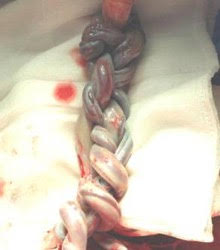
Two cords tangledTwin to twin transfusion syndrome (TTTS) is a random abnormality of a monochorionic placenta that causes one identical twin to receive less than normal amounts of blood supply during pregnancy while the other receives too much. The babies share blood vessels in their placenta that cause an imbalance of blood flow and nutrients between them.

There are degrees to the severity of the syndrome, but it is always life-threatening due to the fact that it can worsen at anytime during pregnancy. Below is a summary of the difference between dizygotic (fraternal) and monozygotic (identical) twin pregnancies. TTTS can only happen with monozygotic twins, or as a pair in a higher multiple pregnancy, that share a single monochorionic placenta.

NOTE: The following information is provided for your information only and does not necessarily reflect each person’s individual situation. If you have any concerns whatsoever about your pregnancy, please consult your physician immediately.

There are two types of twins:

TwinsDIZYGOTIC (DZ)
two eggs meet up with two sperm. These babies are technically siblings who happen to have been born at the same time. They are commonly known as “fraternal”. They always have one placenta each and are called dichorionic (DC).

MONOZYGOTIC (MZ)
one egg meets up with one sperm. These babies are always the same gender and are commonly known as “identical”. MZ pregnancies can experience high complication rates, particularly if the twinning process occurs more than 4 days from fertilization resulting in a single monochorionic placenta share by two or more babies.

There are two types of monochorionic pregnancies that can be affected by twin to twin transfusion syndrome:

MONOCHORIONIC-DIAMNIONIC

When the embryo randomly splits between 4-8 days after conception, the pregnancy results with two babies each in their own amniotic sac (diamnionic) as well as sharing a placenta (monochorionic). The majority of these pregnancies proceed without complications. However, approximately 15% of the time, the babies will share blood between them disproportionately and warning signs of the syndrome will appear on ultrasound (see warning signs below). The syndrome can occur with two or more babies in a higher multiple birth pregnancy as long as the babies share a single monochorionic placenta.

MONOCHORIONIC-MONOAMNIOTIC

When the embryo randomly splits between 8-12 days after conception, the pregnancy results with both babies sharing a single placenta (monochorionic) but the babies are in the same amniotic sac (monoamniotic). This type of pregnancy can still result in TTTS but it is more difficult to diagnose with the babies in the same sac. Also, there is a greater concern that the babies’ cords will become entangled. It is estimated that approximately 50% of the babies will pass away from cord entanglement. It is recommended that mothers be hospitalized at 24 weeks for 24 hour monitoring of the babies until they are born.

One of the warning signs of TTTS shown on ultrasound is a size difference in the babies. One baby, the donor, becomes restricted in growth receiving less then normal blood flow. The donor baby does not urinate very much and has little to no fluid in his or her amniotic sac. Sometimes the baby is referred to as a ‘stuck twin’ or having oligohydramnios. Subsequently, a much larger blood flow goes to the co-multiple, referred to as the recipient twin. Due to the shared, interconnecting veins and arteries in the single placenta, the blood disproportionately flows through the donor twin and collects in the recipient twin, who is unable to efficiently rid his or herself of the extra blood. The recipient baby urinates frequently causing too much amniotic fluid or polyhydramnios. Because of this abnormality in the placenta, both babies’ well-being can be severely compromised.

PLACENTAL SHARE

It is important to understand that one reason babies can become growth restricted is that the babies may share the placenta itself unequally. The donor baby could have less then half of the placenta to nourish it. This is one reason why The Twin to Twin Transfusion Syndrome Foundation advocates weekly ultrasounds from 16 weeks through delivery of the babies. If a baby has a small placental share, and you cannot know prior to birth for sure what the placental share is, the baby will get to a certain gestational week and it will stop growing. The baby will not get enough blood and oxygen from it s share of the placenta to ‘get bigger’ than the size that it is. The rate of growth for the babies is extremely important and is often overlooked. The sharing of the blood from the syndrome also adds to size differences of the babies. TTTS is often combined with an unequal placental sharing.

Some treatment options are available

AGGRESSIVE SERIAL AMNIOCENTECES removal of the excess fluid around the recipient which may need to occur several times;

LASER SURGERY which identifies the connecting blood vessels in the shared monochorionic placenta and cauterizes them with a laser beam. The babies are being separated in the placenta so each will then get their blood supply independently from the other. The scope used is inserted through amniotic cavity of the recipient baby. There are specific criteria that must be met based on ultrasound findings.

BEDREST AND NUTRITION which is explained below and combined with the therapies listed above.

What Can We, as Parents, Do?

  1. Make sure your obstetrician has plenty of high-risk pregnancy experience.
  2. Make sure that your obstetrician uses intensive ultrasound to determine the chorionicity (DC or MC) of the babies as early as possible in the pregnancy. If the babies are like-sexed, you need to know if they share a placenta or each have their own. If they share a placenta, weekly ultrasounds are crucial in the care of your babies and you may have to really fight to have them. Don’t take no for an answer. If the babies are unlike-gender, they must be fraternal twins and cannot have TTTS. Keep asking questions until you are satisfied and understand the answers.
  3. If your babies are monochorionic, take really good care of yourself. One way is to follow advice from Dr. Julian De Lia who pioneered laser surgery almost 20 years ago. He is now recommending adding protein drinks to your diet, such as 3 cans of Boost drinks a day. He feels that TTTS can make mothers malnourished adding to the fluid problem around the recipient babies. Drinking the protein can help get the protein in your blood back to normal. Many women have seen improvements from this. Nutrition is completely overlooked by most doctors. Bedrest is also strongly encouraged along with adding liquid protein. Bedrest is defined as laying horizontally on your left side and getting up to eat, shower, use the bathroom, and go to appointments. Laying on your left side takes pressure off of your cervix and helps increase blood and oxygen to the placenta to help your babies.
  4. Make sure that your cervix is checked weekly. This is also overlooked by many doctors. If your cervix length shortens to 2cm or less, a cerclage or stitching of the cervix can be done up through 25 weeks. This has saved many pregnancies. Laser surgery can still be done after a cerclage only through the 26th week.
  5. If early signs of TTTS appear, or there is a sudden increase in your size, ask for a perinatology appointment immediately. Your feto-maternal medicine specialist will know about the options for treatment. Ask what they think about possible laser treatment and whether this is a possibility for you. Once again, don’t take no for an answer. It is also encouraged by The TTTS Foundation to contact the laser doctors on your own so you get the correct and up-to-date information directly from the doctors who perform the procedure.
  6. Understand a monochorionic placenta and what TTTS is. Understand specifically what is happening to your babies with measurements of their size difference, your fundal height, the biggest pocket of fluid around each baby, where your placenta is located in the uterus, their doppler readings and your cervix. Create a medical plan of action with back-up plans so you can be as prepared as you can for each appointment.

Warning Signs of TTTS

  •  a large-for-dates uterus
  • water in baby(ies) body (heart failure called hydrops)
  • a single placenta
  • same sex babies
  • growth discordance, babies are growing at different rates
  • too much amniotic fluid in one sac and too little in the other
  • being 16-26 weeks pregnant with fundal height of 30 cm or more
  • a doppler reading for the babies which is absent diastolic or reverse flow
  • a cervix which is thinning and shortening to 2cm or less
  • sudden weight gain and/or swelling in the mother’s body

The TTTS Foundation says that without treatment, the death rate for twins who develop TTTS at mid-pregnancy (16 to 26 weeks gestation) may be as high as 80-100, mostly as a result of premature delivery. The later the condition develops in the pregnancy, the better chance the babies have since they could be delivered if signs of distress are present. Your health care professional is the best source of information regarding your personal situation and can discuss fully with you how your situation can be managed. However, remember that the ultimate decisions for your children are yours.

Please also note that TTTS can occur with monozygotic (identical) sets of babies in triplets, quads or quints and not just twins.  If you are pregnant with multiples, you need to know if you are carrying any monozygotic babies and if they have TTTS.

Definitions

Diamniotic twins: twins who have developed in separate amniotic sacs. They may be either dizygotic or monozygotic.
Dichorionic twins: twins who have developed in separate chorionic sacs. They may be either dizygotic or monozygotic.
Dizygotic twins: twins formed from two separate zygotes.
Fraternal twins: see dizygotic twins
Higher order multiples: triplets, quadruplets, quintuplets or more
Hydropic (hydrops): a condition due to the abnormal accumulation of serous fluid in the tissues or in a body cavity
Identical twins: see monozygotic twins
Monoamniotic twins: twins who have developed in a single amniotic sac. These twins are always monozygotic.
Monochorionic twins: twins who have developed in a single chorionic sac. These twins are always monozygotic.
Monozygotic (monozygous) twins: twins formed from a single zygote.
Oligohydramnios: the presence of too little amniotic fluid around a baby.
Polyhydramnios: the presence of too much amniotic fluid around a baby.
Serous fluid: a thin and watery fluid
Zygote: a fertilized ovum.

Twin to twin transfusion syndrome (TTTS): results from abnormalities of the placenta in monozygous twin pregnancies. TTTS results from blood passing disproportionately (transfusing) from one twin baby to the other through connecting blood vessels within the shared (monochorionic) placenta. (TTTS Foundation)

Written by Lynda P. Haddon, Multiple Birth Educator, www.jumelle.ca

Consultation Sources for this article

  • Elizabeth Bryan, M.D., FRCP, FRCPCH, Founder, Multiple Births Foundation, London, England
  • Mariana Herskovitz, M.D., General Practice, Ottawa, Canada
  • Dr. Geoff Machin, Department of Pathology, Kaiser Medical Center, Oakland, California, USA
  • Mary Slaman-Forsythe, BS. MNO, Founder and President, The Twin to Twin Transfusion Syndrome Foundation, Bay Village, Ohio, USA
  • Julia Watson-Blasioli, R.N., B.Sc.N., Ottawa Hospital, General Campus

Sources

  • Multiple Blessings, by Betty Rothbart, 1994
  • Double Duty by Christina Baglivi Tinglof, 1998
  • Twins! Pregnancy, birth and the first year of life, by Connie L. Agnew, Alan H. Kein and Jill Alison Ganon, 1997
  • Twin to Twin Transfusion Syndrome Foundation, literature
  • Dr. Julian E. Delia, Founder and Director of the International Institute for the Treatment of Twin to Twin Transfusion Syndrome, St. Joseph’s Woman’s Hospital, Milwaukee, WI WS: tttsmd.com

Other Resources

Grief, How Can I Help?

Question: My neighbours lost one of their triplet sons. I feel helpless and don’t know how to help. How can I effectively support the family at this very sad time?

For several reasons grief is very difficult to deal with: Grief has no time line; Grief is very personal and everyone grieves differently; and there is no telling what may trigger sad and painful feelings. Additionally, grief, for the same individual, becomes different as they walk along its rocky and difficult path. The individuality of grief and where a person in his grief journey, makes it difficult to know exactly how to aid and support someone attempting to heal. Another factor which can impede helping someone is our own inhibitions regarding death and in not knowing how to approach a grieving person. It may be easier for some of us to ignore a grieving person, perhaps with a mumbled “Hello”, no eye contact and then to get on with our own lives.

The following has been prepared in order to assist you when you come into contact with someone who has suffered a loss. I hope that you will find it of assistance.

NOTE: “Loss” is defined as any major loss – e.g. loss of employment, house fire, divorce, as well as bereavement. This article deals with loss by death.

  1. Step forward and approach the bereaved individual. Put out your hand or offer them a hug, if the situation is appropriate. Make eye contact and say, “I am so sorry!” Often that will be enough to allow the person to speak of their pain.
  2. Be a good listener. This rule applies in so many different areas of our lives and is extremely important when listening to a bereaved person. Don’t add to their situation by recounting horror stories of your own. It is not a time for one-upmanship of stories. This is their time and a time for you to listen, to perhaps once again say, “I am so sorry.” Or “It just isn’t fair.” Don’t take up this time with yourself but give freely of your listening skills. Don’t be afraid to use the deceased’s name during the conversation. If you don’t know what they name the baby(ies), ask them. They will appreciate the validation of their baby’s existence. Families need to speak of their lost one(s), including using their names.
  3. Be prepared to make yourself available. Make sure you don’t give them the impression of “hurrying” or speeding them along because you need to be elsewhere or because you feel uncomfortable.
  4. Try to accept the words shared with you. A grieving individual may rail against life, G-d, the doctors, the world. Don’t make harsh judgements. Just accept the words as they come. In an effort to get rid of our pain, it is not unusual to make rash and/or harsh statements.
  5. There are many concrete ways in which you can assist – take care of other children for a while, bring over a meal, send a card, make a donation to an appropriate charity, attend the wake, funeral or memorial service, make a cup of tea for the parents. Ask how you can help.
  6. Don’t minimize the loss – “You can have more children.” “It’s better this way. Your baby was sick.” “She has gone to a better place.” “G-d needed her more than you did.” None of these remarks are helpful to a grieving parent. Children are not interchangeable and “having another one” will not replace what should have been and “a better place” is here with her family. Families who have survivors of multiple birth children are often not given the proper space to grieve their loss. In a bereavement counselling group session, parents of a surviving twin where yelled at by a mother who had lost her singleton child, “Why are you here? You have a baby, I have none!” Minimizing anyone’s loss does not help.
  7. Don’t forget to acknowledge the father’s grief too. Too often the Mom is consoled while Dad is expected to “Hang tough.” Some people ask Dad how Mom is doing and don’t even think of asking him how he is. Dad too, has lost a child and experiences feelings of loss and pain. He has the added burden of society’s expectations that he can “cope.” He may be split between a child(ren) at home, a baby in the NICU, his job, planning a funeral, and his wife recovering from a c-section. He will also need your support.
  8. There are no shortcuts through grieving. Any attempt at a shortcut can only make things worse. Try and allow the bereaved person as long or as short a period as they need. Be patient. Avoid tell the person how they “should” feel or act or what they “should” do to make things easier. Also avoid saying “You are handling it so well” as this puts people into a box. Remember that there is no time limit on grief and several months down the road, these families still do not feel “normal”. They are trying to adapt to a new reality. They have still lost their child(ren) and nothing will ever change that.
  9. Encourage the bereaved person to look after themselves. To eat properly (it is not unusual for a bereaved person to stop eating and drinking), to see to their own needs and not to make important decisions right away. They need time first to grieve and heal.
  10. Remember that you are not responsible for this person’s pain. You didn’t cause it and because your children are alive and healthy, try not to feel guilty about it.
  11. Remember that you cannot take away their pain but you can assist them over the rocky path. You can be supportive and caring. You will not have all of the answers and, often there are not any answers at all. Life happens with no apologies or excuses and sometimes, it can be quite unfair. They did nothing wrong to deserve this.
  12. You may find it prudent to recommend some professional counselling, a physician, religious figure, grief counsellor or therapist. The library has books on death and dying and there are workshops, seminars or support groups that can also be of assistance. Your local funeral home will also be able to guide you in this area.
  13. One way a Chapter can be of assistance is to donate Multiple Births Canada’s Loss Booklets to the funeral homes and neonatal hospital units in your Chapter area. Such a donation will assist the professionals in being aware of the family’s unique needs.

Additional Resources:

  • Empty Cradle, Broken Heart, Deborah L. Davis, Ph.D., Fulcrum Publishing
  • The Worst Loss: How Families Heal from the Death of a Child, Barbara D. Rosof, Henry Holt and Company
  • On Children and Death, Elisabeth Kubler-Ross, Collier Books
  • Life After Loss, Bob Deits, Fisher Books
  • Men & Grief, Carol Staudacher, New Harbinger Publications
Did you do something special by way of support for a bereaved family and would like to share that idea with others? Write and let me know how you helped someone deal with the loss of their precious child(ren).

Useful Safety Tips for Parents of Multiples

Having two, three, four or more toddlers and preschoolers around the house can make keeping them safe a challenge.  There in no way cover all of the possible dangers of having more than one child of the same age and of the possible safety difficulties that might develop.  Following are some safety tips to help you keep your children safe.

Remember that NO precautions are foolproof in the face of more than one determined child.

THERE IS NO SUBSTITUTE FOR RESPONSIBLE, ALERT ADULT SUPERVISION AT ALL TIMES.

In the Home

  • Childproof your house every day.  It is a good idea to crawl around the house in order to view it from a child’s point of view.
  • If you don’t want it broken, remove it!
  • Make sure that you have a house key hidden outside of your house.
  • Make sure where you visit is childproofed e.g. Gramma’s, sister’s house, etc.
  • Never leave the kids alone in a bathroom or in a bath.
  • Toddlers can be very rough with pets.  Teach children to respect them.
  • While dealing with a crisis with one child, remember that you are still responsible for the safety of your other children.  STAY ALERT!  This is where those “eyes in the back of your head” can come in very handy.
  • Important for partner and any other caretakers to be equally safety conscious.
  • Tape electrical cords to the floor/walls for the time the kiddies are exploring their environment.
  • Make sure that your hot water heater is not set too high.  Kids have been scalded when a sibling has turned on the hot water.
  • Watch for loose air vents in your home.  Small children can slip down them and they make good receptacles for toys, bottles, food, etc.
  • Dresser drawers make good climbing stairs. Purchase very low dressers, bolt a higher dresser to the wall or turn the drawer side into the wall until their climbing stage is over.  Children can be fatally or seriously injured when two or more children try to climb dressers.
  • Ditto for bookcases, turn them to the wall and anchor them.
  • Check out accessibility to fireplaces (e.g. one twin pushed his co-twin up into a chimney and he got stuck), appliances (e.g. fridges, dryers, ovens, etc.)
  • Do not place cribs near windows.  Screens can be removed and toddlers tumble out.
  • Two (or three) children can push a chair across a room to climb up onto countertops or reach higher objects.
  • Safely secure medicines and cleaning chemicals.  “Child-proof” containers are not so “child-proof” when set upon by two or more determined children.
  • Many issues occur at nap-time because children often share the same room and “encourage” each other in their creativity and exploration.  E.g. peeling off the wallpaper, emptying dresser drawers and climbing them, taking screens off windows and climbing out, finding the talcum powder and emptying it all over (makes breathing difficult), and the list goes on…  Using a portable intercom may reduce potential hazards.  If you wish to rest at the same time, as the children, place the intercom right near your ear.
  • Put safety catches on all cupboards, drawers, screens, kitchen doors, etc..
  • Put covers on electric plug outlets.
  • Stereos and TVs can be pushed off entertainment centers.  You may wish to either put them higher or bolt them down securely.
  • Use gates and locked doors to seal off areas of the house where you don’t want them to go. E.g. laundry rooms, garage, etc.
  • No shoving, pushing or running on the stairs.  Many siblings have been pushed in play.
  • When walking down the stairs with the children and carrying something such as a laundry basket, keep it to the side so that your view of anyone on the stairs is not impeded.

Equipment

  • Make sure ALL baby equipment is in good repair.  Check them at regular intervals.
  • Make sure clothing and blinds have no long cords that can entrap and choke.
  • Never assume the suggested age-range for baby equipment is appropriate for your children. Check each one out carefully and individually.
  • Make sure the kids are harnessed into swings, car seats, highchairs, etc. Kiddies can easily undo each other and then get into further mischief.
  • Security gates receive an extensive workout when 2 or more are climbing, shaking or pulling on it.  Check it regularly to make sure it remains securely bolted into the wall.
  • If your children are weight discrepant, change their seating location each outing in the stroller in order to give it equal wear.
  • Cribs need to be dismantled when the kids begin to attempt to climb out.
  • Check second hand equipment very carefully.  Look for outdated safety features, cracks, or rips.
  • A baby backpack (with frame) should only be used after a baby can hold its head up.

Toys

  • Purchase toys that appeal to kids and encourage play.
  • Toys belonging to older siblings can be a source of danger.
  • Always check out second hand toys very carefully prior to purchasing.  Look for small pieces, sharp edges, and broken parts.
  • Crib mobiles are not toys and need to be removed from the crib when a baby can reach it.
  • Regularly check the toys for missing parts, chips, and cracks.  Our children put a lot of play, stress and strain on toys and as a result, the toys may not last as long as if only one child was playing with them.

In the Vehicle

  • Teach everyone to stand clear when closing ANY doors.
  • Discourage the slamming of doors.  Someone could get hurt or fingers caught.
  • While fastening one child into a car, the other(s) can disappear in a flash.  Put all the children loose in the car, and then buckle in one at a time.
  • NEVER leave children alone in a running car.  They can get loose and put the car in gear.
  • ALWAYS put your car in “park” or turn it off when someone is disembarking.
  • If you have to leave the car while escorting one child up to a friend’s house, take the ignition key with you.
  • Play a road game of teaching the kids to identify road signs, e.g. danger, one-way signs, railroad tracks, etc.
  • Be aware that with everyone sitting close to each other in car seats, it is very easy for one to reach over and undo the buckle of the next one.  If you find that one of children has unbuckled the other DON’T PANIC!  Use your voice to tell your child to stand still.  Pull your vehicle over to the side of road, stop completely and then deal with putting your child back into his seat.
  • Do not “store” articles on the floor in front of your children.  In a crash these items become flying objects and can inflict serious injury.

Water

  • Place your children into swim classes at your earliest possible convenience.
  • When swimming with your children keep alert.  Accidents occur when the adult is distracted with one child.
  • Do NOT leave your children in charge of an older sibling.  An 8 -year old cannot properly “watch” two two-year olds.
  • Discuss safety equipment and why we need it, e.g. life jackets, pool equipment, etc.
  • NEVER let them swim without an adult who can swim being present.  If you are hiring day care and you have access to a pool, you may wish to ask if the applicant can swim.
  • No pushing or shoving around water as small kids love to do.
  • NEVER leave the kids alone in a bathtub.  If the phone rings, leave it!
  • When your home is one side of the fence around your pool, make sure that the door to the house has a high and sturdy lock on it.
  • If you are taking several children to the beach/pool, determine ahead of time who will be responsible for whom.  This way each adult knows who will be watching whom.

Complacency

As the children are older, a level of complacency can be experienced by parents when their multiples are with each other.  This level of comfort can too easily create a feeling of safety and security that does not necessarily exist.  “Oh, they are together, it shouldn’t be a problem.”  Some times this is when kids can get into the most trouble.  This is particularly true of the middle, pre-teen and teen years.

General Safety Precautions

  • Stress staying together on outings.  The kids, too, have a responsibility not to get lost.  Train yourself to count heads every few minutes.
  • Practice, practice, practice, e.g. Look both ways and holding hands while crossing a road, reading road signs, danger signs, etc.
  • Repeat safety rules to them on a regular basis, e.g. knives and scissor are sharp, remember to keep an eye on Daddy/Mommy while we are out.
  • Dressing your children in bright colours makes them easier to locate while out in public.
  • When walking in unconfined areas (e.g. store, shopping mall), keeping everyone in a stroller or on a wrist harness may be the way to go.
  • Stress to them that they shouldn’t cut each other’s hair.  Don’t say you weren’t warned!
  • Firm reminders of safety rules with consistent “time out” reinforcement or infractions.
  • Remember that some things are just not negotiable, e.g. car seat belts!
  • Teach them identifying landmarks in the neighbourhood so they can find or direct someone home.
  • Teach them their phone number and area code as soon as they are able to learn.  They also need to know your first names and their last names.   If someone gets lost, it is important for them to know your first and last names.
  • When completing a difficult task, e.g. climbing a climber, encouraging them to “concentrate” on what they are doing helps them not to be distracted.
  • Multiples often attempt to “change” each other’s diapers.  Be aware!
  • Remember that your younger children are NOT the responsibility of your older children.  A ten-year-old cannot adequately look after and make responsible decisions for 2 or 3 four-year-olds.
  • Never carry your stroller up the stairs with babies in it.
  • Never leave babies alone in a stroller.
  • Make sure everyone is holding hands BEFORE you cross the street.
  • NOTHING beats constant, alert, vigilant adult supervision.